
 This image combines all of STEREO's wavelengths into one three-dimensional photograph (visible with 3D anaglyph glasses). Credit: NASA |
"If space weather forecasters rely on some of the traditional danger signs, they'll miss a significant fraction of solar eruptions," said Suli Ma of the Harvard-Smithsonian Center for Astrophysics (CfA).
To reach their conclusion, Ma and her colleagues studied 34 solar eruptions over 8 months using the STEREO spacecraft. STEREO allows us to study the Sun from two different angles simultaneously. It consists of two spacecraft, one ahead of Earth in its orbit and the other trailing behind. The researchers used it to ensure that the events leaving the Sun were definitely on the side facing the Earth.
STEREO is ideal for studying coronal mass ejections, or CMEs. A CME is a huge eruption from the Sun that blasts a billion tons of highly charged particles into space at speeds greater than a million miles per hour.
When those charged particles reach Earth, they interact with our planet's magnetic field, potentially creating a geomagnetic storm. Such a storm can interfere with satellite communications, disrupt power grids, or even short out orbiting satellites.
Previous to STEREO, astronomers thought that all Earth-facing CMEs were accompanied by warning signals like flares (smaller explosions accompanied by high-energy radiation), coronal dimmings (darkening of the corona caused by discharge of matter in the CME) or filament eruptions (long ribbons of plasma arching violently out from the solar surface). Therefore, by watching for those signals, we could potentially predict an impending eruption.
This new research found that 11 of the 34 CMEs observed by STEREO were "stealthy," showing none of the usual signals. As a result, any system designed to watch for such warning signs could miss one-third of all solar blasts.
"Meteorologists can give days of warning for a hurricane, but only minutes for a tornado," explained Smithsonian astronomer Leon Golub. "Currently, space weather forecasting is more like tornado warnings. We might know an eruption is imminent, but we can't say exactly when it will happen. And sometimes, they catch us by surprise."
The team plans to continue looking for subtle clues that might allow us to predict an impending "stealth" CME. They caution that their study occurred during a prolonged minimum of solar activity; conditions may change as solar activity increases over the next few years.
"The Sun is entering its stormy season, ramping up toward its next period of maximum activity in 2013 and 2014," said Ma. "The more we learn and understand about it now, the better."
The paper discussing their findings appeared in the Oct. 10, 2010 issue of The Astrophysical Journal. It was authored by Suli Ma, G. Attrill, and Leon Golub (CfA); and J. Lin (Chinese Academy of Sciences).
 del.icio.us del.icio.us |
 Digg Digg |
 Reddit Reddit |
 YahooMyWeb YahooMyWeb |
 Google Google |
 Facebook Facebook |

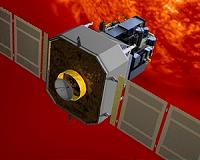 Solar Observation Mission Celebrates 15 Years
| The content herein, unless otherwise known to be public domain, are Copyright 1995-2010 - SpaceDaily. AFP and UPI Wire Stories are copyright Agence France-Presse and United Press International. ESA Portal Reports are copyright European Space Agency. All NASA sourced material is public domain. Additional copyrights may apply in whole or part to other bona fide parties. Advertising does not imply endorsement,agreement or approval of any opinions, statements or information provided by SpaceDaily on any Web page published or hosted by SpaceDaily. Privacy Statement |


