
Subscribe free to our newsletters via your
. Military Space News .


FARM NEWS
Soil production breaks geologic speed record
by Staff Writers
Seattle WA (SPX) Jan 21, 2014


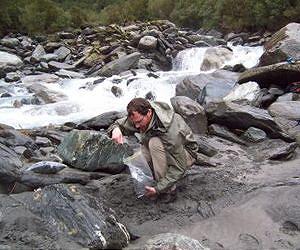
Isaac Larsen collects a sand sample at the Rapid Creek test site. Image courtesy Krista Larsen.

Geologic time is shorthand for slow-paced. But new measurements from steep mountaintops in New Zealand show that rock can transform into soil more than twice as fast as previously believed possible.

The findings were published Jan. 16 in the early online edition of Science.

"Some previous work had argued that there were limits to soil production," said first author Isaac Larsen, who did the work as part of his doctoral research in Earth sciences at the University of Washington. "But no one had made the measurements."

The finding is more than just a new speed record. Rapidly eroding mountain ranges account for at least half of the total amount of the planet's weathering and sediment production, although they occupy just a few percent of the Earth's surface, researchers said.

So the record-breaking production at the mountaintops has implications for the entire carbon cycle by which the Earth's crust pushes up to form mountains, crumbles, washes with rivers and rainwater to the sea, and eventually settles to the bottom to form new rock.

"This work takes the trend between soil production rates and chemical weathering rates and extends it to much higher values than had ever been previously observed," said Larsen, now a postdoctoral researcher at the California Institute of Technology in Pasadena.

The study site in New Zealand's Southern Alps is "an extremely rugged mountain range," Larsen said, with rainfall of 10 meters (33 feet) per year and slopes of about 35 degrees.

To collect samples Larsen and co-author Andre Eger, then a graduate student at Lincoln University in New Zealand, were dropped from a helicopter onto remote mountaintops above the tree line. They would hike down to an appropriate test site and collect 20 pounds of dirt apiece, and then trek the samples back up to their base camp. The pair stayed at each of the mountaintop sites for about three days.

"I've worked in a lot of places," Larsen said. "This was the most challenging fieldwork I've done."

Researchers then brought soil samples back to the UW and measured the amount of Beryllium-10, an isotope that forms only at the Earth's surface by exposure to cosmic rays. Those measurements showed soil production rates on the ridge tops ranging from 0.1 to 2.5 millimeters (1/10 of an inch) per year, and decrease exponentially with increasing soil thickness.

The peak rate is more than twice the proposed speed limit for soil production, in which geologists wondered if in places where soil is lost very quickly, the soil production just can't keep up. In earlier work Larsen had noticed vegetation on very steep slopes and so he proposed this project to measure soil production rates at some of the steepest, wettest locations on the planet.

The new results show that soil production and weathering rates continue to increase as the landscape gets steeper and erodes faster, and suggest that other very steep locations such as the Himalayas and the mountains in Taiwan may also have very fast soil formation.

"A couple millimeters a year sounds pretty slow to anybody but a geologist," said co-author David Montgomery, a UW professor of Earth and space sciences. "Isaac measured two millimeters of soil production a year, so it would take just a dozen years to make an inch of soil. That's shockingly fast for a geologist, because the conventional wisdom is it takes centuries."

The researchers believe plant roots may be responsible here. The mountain landscape was covered with low, dense vegetation. The roots of those plants reach into cracks in the rocks, helping break them apart and expose them to rainwater and chemical weathering.

"This opens up new questions about how soil production might happen in other locations, climates and environments," Larsen said.

Other co-authors are John Stone at the UW; and Peter Almond and Brendon Malcolm at Lincoln University in New Zealand. The research was funded by the National Science Foundation, the Royal Society of New Zealand, NASA, the Geological Society of America and the UW Earth and Space Sciences Department.

.


Related Links
University of Washington
Farming Today - Suppliers and Technology


Comment on this article via your Facebook, Yahoo, AOL, Hotmail login.

Share this article via these popular social media networks
del.icio.usdel.icio.us DiggDigg RedditReddit GoogleGoogle


FARM NEWS
Uruguay farmers set against open-pit iron ore mine
Montevideo, Uruguay (UPI) Jan 16, 2013
Uruguayan miners and environmentalists are increasingly set against President Jose Mujica going ahead with an open-pit iron ore mine's development, which they want scrapped. The 78-year-old former guerrilla leader, who sees the Valentines iron ore mine as a crowning legacy of his presidency, has angered traditional constituencies of supporters with moves critics say are neither fair nor ... read more


FARM NEWS
Raytheon resumes work on US Navy Air and Missile Defense Radar

Israel's Rafael and Raytheon to co-produce Iron Dome

Lockheed Martin Advances Affordability Across U.S. Navy's Aegis Weapons System To Secure Multi-Year Contract

Boeing and Israel Aerospace Industries' Arrow 3 Interceptor Completes Second Flight Test

FARM NEWS
Longbow Missiles Demonstrate Littoral Attack Capability

Lockheed Martin Tests LRASM MK 41 Vertical Launch System Interface

Raytheon receives SM-3 contract

Iran mulls replacement for Russian S-300 missile system

FARM NEWS
Someday A Drone Might Save Your Life

McCain fury over 'secret' Congress move on drones

Hunter Unmanned Aircraft System Surpasses 100,000 Combat Flight Hours

Northrop Grumman's Global Hawk Boasts Best Safety Record Designation

FARM NEWS
Boeing Transmits Protected Government Signal Through Military Satellite

Boeing Transmits Protected Government Signal Through Military Satellite

Fifth MUOS Completes Assembly, Enters System Test

Northrop Grumman Supports US Marine Corps Command, Control and Communications Facility for Tactical Air Operations

FARM NEWS
The right stuffing: Turkeys enlisted in terror fight

US Navy Awards Lockheed Martin Contract for Production of Paveway II

US probes Honeywell over sensor made in China

Kongsberg to upgrade Australia's Protector stations

FARM NEWS
More defense cuts seen likely as Canada tightens its budget belt

Riyadh's $3B arms aid for Lebanon boosts French defense sales

Africa grows in importance for defense companies

Israel, Singapore seek FMS deals

FARM NEWS
China plans new patrol in disputed South China Sea: media

China leaders' kin stash riches in offshore tax havens: probe

Japan tells world to stand up to China or face consequences

Relocation of Marine's Okinawa base will go ahead

FARM NEWS
Carbon nanotube sponge shows improved water clean-up

Layered security: Carbon nanotubes promise improved flame-resistant coating

Layered security: Carbon nanotubes promise improved flame-resistant coating

Molecular nano-spies to make light work of disease detection


The content herein, unless otherwise known to be public domain, are Copyright 1995-2014 - Space Media Network. AFP, UPI and IANS news wire stories are copyright Agence France-Presse, United Press International and Indo-Asia News Service. ESA Portal Reports are copyright European Space Agency. All NASA sourced material is public domain. Additional copyrights may apply in whole or part to other bona fide parties. Advertising does not imply endorsement,agreement or approval of any opinions, statements or information provided by Space Media Network on any Web page published or hosted by Space Media Network. Privacy Statement