|
 |
 |
 |
 |
 |
 |
 |
 |
 |

| . |  |
. |
Solar Games At Paranal
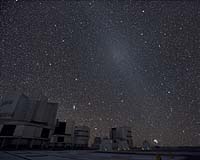
Cerro Paranal, Chile (SPX) May 05, 2008 Cerro Paranal, home of ESO's Very Large Telescope, is certainly one of the best astronomical sites on the planet. Stunning images, obtained by ESO staff at Paranal, of the green and blue flashes, as well as of the so-called 'Gegenschein', are real cases in point. The Earth's atmosphere is a gigantic prism that disperses sunlight. In the most ideal atmospheric conditions, such as those found regularly above Cerro Paranal, this will lead to the appearance of so-called green and blue flashes at sunset. The phenomenon is so popular on the site that it is now the tradition for the Paranal staff to gather daily on the telescope platform to observe the sunset and its possible green flash before starting their long night of observations. The green and blue flashes are fleeting events that require an unobstructed view of the setting Sun, and a very stable atmosphere. These conditions are very often met at Paranal, a 2635m high mountain in the Chilean Atacama Desert, where the sky is cloudless more than 300 days a year. Paranal is home of ESO's Very Large Telescope, an ensemble of four 8.2-m telescopes and four 1.8-m Auxiliary Telescopes that together form the world's most advanced optical telescope. ESO staff Stephane Guisard has been chasing green flashes for many years and has been able to capture them on many occasions. The picture shown above is one of many examples from his collection. "The most challenging is to capture the green flash while still seeing the rest of the Sun with all its colours," says Guisard. His colleague Guillaume Blanchard was even luckier. On Christmas Eve, as he was one of the few to follow the tradition of looking at the sunset, he had the chance to immortalise a blue flash using his hobby telescope. ESO astronomer Yuri Beletsky also likes to take photographs from Paranal, but he prefers the night views. This allows him to make use of the unique conditions above the site to make stunning images. On some of these, he has captured other extremely interesting effects related to the Sun: the so-called Zodiacal light and the 'Gegenschein'. Both the Zodiacal light and the Gegenschein (which is German for "counter shine") are due to reflected sunlight by interplanetary dust. These are so faint that they are only visible in places free from light pollution. Most of the interplanetary dust in the Solar System lies in the ecliptic, the plane close to which the planets are moving around the Sun, and the Zodiacal light and Gegenschein are thus seen in the region centred around the ecliptic. While the Zodiacal light is seen in the vicinity of the Sun, the Gegenschein is seen in the direction opposite to the Sun. Each of the small particles of dust, left over from comets and asteroids, acts as a small Moon reflecting the light coming from our host star. "If you could see the individual dust particles then you would see the ones in the middle of the Gegenschein looking like very tiny full moons, while the ones hidden in the faint part of the dust band would look like tiny crescent moons," explains ESO astronomer Colin Snodgrass. "But even the VLT cannot see such tiny individual dust particles out in space. Instead we see the combined effect, in photos like these, of millions of tiny dust particles reflecting light back to us from the Sun." Community Email This Article Comment On This Article Related Links ESO Solar Science News at SpaceDaily
 Temporary cooling trend may offset warming
 New York (UPI) May 2, 2008
 German scientists said temporary climate variations may temporarily offset the long-term global warming trend. |
|
|

| The content herein, unless otherwise known to be public domain, are Copyright 1995-2007 - SpaceDaily.AFP and UPI Wire Stories are copyright Agence France-Presse and United Press International. ESA Portal Reports are copyright European Space Agency. All NASA sourced material is public domain. Additional copyrights may apply in whole or part to other bona fide parties. Advertising does not imply endorsement,agreement or approval of any opinions, statements or information provided by SpaceDaily on any Web page published or hosted by SpaceDaily. Privacy Statement |