|
 |
 |
 |
 |
 |
 |
 |
 |
 |

| . |  |
. |
Soldering Surprise
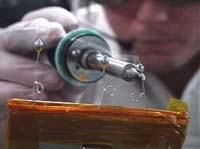
Huntsville AL (SPX) Aug 17, 2004 Richard Grugel, a materials scientist at the Marshall Space Flight Center, watched his video monitor in disbelief. A transmission from the International Space Station was playing. The scene: Astronaut Mike Fincke touches the tip of a soldering iron to a wire wrapped with rosin-core solder. Here's what happened: The solder, heated, became a molten blob with a droplet of rosin clinging tight to the outside. Solder melts: that's not too surprising. It's the behavior of the rosin that amazed. As the temperature increased, the droplet began to spin, round and round, faster and faster, like a miniature carnival ride. "What a surprise," says Grugel. "I've never seen anything like it." Grugel is the principal investigator of the In-Space Soldering Investigation, or "ISSI" for short, which Fincke was doing at the time of the discovery. ISSI's purpose is to find out how soldering works in a weightless environment. This is important information for astronauts. If something breaks during a long trip to Mars, they'll likely reach for a soldering iron to repair it. Researchers have long known that soldering in space isn't the same as soldering on Earth. Here on Earth, gravity pulls molten solder down over the metals to be joined. In space, weightless solder doesn't flow down. It tends to gather in blobs held together by surface tension. Trapped inside those solder-blobs, Grugel believes, are tiny bubbles of gas, vaporized rosin and steam, that weaken the joint and lessen its electrical and thermal conductivity. The solder Fincke used for ISSI is a mixture of lead, tin and rosin. The purpose of lead and tin is to form an electrically conducting connection. What does the rosin do? Grugel explains: "When metals are exposed to air, they become coated with oxides." Iron, for example, rusts: iron oxide. "The purpose of rosin," he says, "is to wash away any oxides before the lead and tin solidify, clearing the way for a good strong connection." Clearly, though, some of the rosin is too busy flying around to do its job properly. Is this a problem? To find out, Grugel plans to slice the blobs created by Fincke and examine what lies inside. He'll be able to see how many weakening bubbles are in there, and whether the solder made a clean connection to the wire. The samples will be returned to Earth by astronauts in a Soyuz capsule or, perhaps, after the space shuttle returns to flight. The date isn't set. Meanwhile, Grugel and his colleagues are brainstorming, trying to understand what causes the rosin to twirl. "We almost have it," Grugel says, but he's not ready to announce a solution yet. He does, however, have some advice for astronauts bent on soldering: wear your goggles and watch out for flying rosin. Related Links ISSI at NASA SpaceDaily Search SpaceDaily Subscribe To SpaceDaily Express  New Cargo Ship Arrives At Space Station
 Houston TX (SPX) Aug 17, 2004
The Russian ISS Progress 15 cargo ship delivered supplies and equipment to the International Space Station early Saturday. The Progress linked up with the aft end of the Station's Zvezda Service Module at 1:01 a.m. EDT. |
|
|

| The content herein, unless otherwise known to be public domain, are Copyright 1995-2006 - SpaceDaily.AFP and UPI Wire Stories are copyright Agence France-Presse and United Press International. ESA PortalReports are copyright European Space Agency. All NASA sourced material is public domain. Additionalcopyrights may apply in whole or part to other bona fide parties. Advertising does not imply endorsement,agreement or approval of any opinions, statements or information provided by SpaceDaily on any Web page published or hosted by SpaceDaily. Privacy Statement |