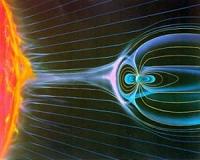
First observed in the waters of a Scottish canal in 1834, solitary waves or solitons, have nowadays applications across various fields of physics, including optical fibres to enable ultra-fast internet. However, fundamental questions on this phenomenon remain open. For the first time, spontaneous formation of solitons in space, at the border of the Earth's magnetosphere called magnetopause, is reported and explained in a recent article published in Physical Review Letters.
The combined observations made by the four satellites of the Cluster mission were found in good agreement with numerical simulations, thus confirming earlier theoretical predictions of their existence.
In 1834, John Scott Russell a ship designer and scientist was observing a boat being drawn along by a pair of horses. When the boat suddenly stopped he noticed that the bow wave continued forward: "at great velocity, a large solitary elevation of water which continued its course along the channel apparently without change of form or diminution of speed," reported Russell.
Intrigued, he followed the wave on horseback as it rolled on at more than 10 kmh-1, but after a chase of a few kilometres he lost it. He called this phenomenon "Wave of translation" and published the first paper on this subject in 1845.
It wasn't until the 1960's that scientists realized just how important Russell's discovery had been. They reasoned that if a water wave was able to retain its form over a long distance, what about other types of waves like light? Today's most advanced optical fibre communications use stable pulses of light identical to Russell's waves, now called solitons, to carry masses of information over thousands of kilometres of optical fibres. This enables crystal clear international phone calls and ultra-fast internet.
Similar soliton-like structures have been found in the field of plasma physics including inside experimental nuclear fusion reactors using tokamaks to magnetically contain plasma. Probing such a phenomenon in these experimental devices is difficult as the probe itself often perturbs the medium being investigated. Space is a better environment than a fusion reactor to study solitons because the probe (satellite) can easily penetrate all regions of interest without experiencing any damage.
Cluster Observations and Numerical Modelling of Solitons
On 30 March 2002, the four satellites of the Cluster mission were flying in formation across the magnetopause at ~ 50 000 km distance from Earth. De Keyser et al. (2005) and Silin et al. (2005) reported the presence of electric field turbulence within the magnetopause during this crossing, consisting of a special type of waves called lower-hybrid waves. Making use of the simultaneous electric field measurements by three Cluster satellites, Trines et al. (2007) reveal the presence of a solitary wave structure breaking away from this turbulent region.
"From the known separation of the spacecraft and the order in which they crossed the magnetopause, we infer that this structure moves down into the magnetosphere at a speed of roughly 8-9 kms-1 and has a size of 6-7 kilometres, estimations only possible with multiple spacecraft," says Raoul Trines lead author of this result published 16 November 2007 in Physical Review Letters. Dr. Trines is a scientist at the Rutherford Appleton Laboratory (UK).
This detection of solitons is reported together with numerical simulations in order to investigate the mechanisms governing the emergence and propagation of these solitary structures. The numerical code was originally developed to study a similar phenomenon in tokamaks [Trines et al., 2005]. The simulations were able to reproduce the formation of such solitary structures both qualitatively and quantitatively (e.g. comparable size and speed), thus confirming earlier theoretical predictions of their existence.
"Cluster is the first mission in space able to compare natural phenomena such as solitons with theoretic models in much more detail than any other mission thanks to its unique capability of differentiating spatial from temporal variations. This result is one of the scientific highlights of the mission," comments Philippe Escoubet, Cluster and Double Star scientist of the European Space Agency.