|
 |
 |
 |
 |
 |
 |
 |
 |
 |

| . |  |
. |
Solving A Solar System Quandary By Flip-Flopping Uranus And Neptune
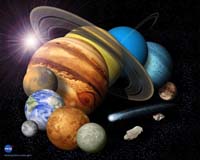
Tempe AZ (SPX) Dec 13, 2007 Quick: What's the order of the planets in the solar system? Need a little help? Maybe the following mnemonic rings a bell: "My Very Educated Mother Just Served Up Nine Pizzas." It's useful for remembering the order of the planets today, but it wouldn't have been as useful in the past, and not just because the International Astronomical Union demoted Pluto to "dwarf planet" last year. The reason this mnemonic wouldn't have worked is because the planets weren't always in the order they are today. Four billion years ago, early in the solar system's evolution, Uranus and Neptune switched places. This is the result of recent work by Steve Desch, assistant professor in the School of Earth and Space Exploration at Arizona State University. The work appears in this week's Astrophysical Journal. Desch based his conclusion on his calculations of the surface density of the solar nebula. The solar nebula is the disk of gas and dust out of which all of the planets formed. The surface density - or mass per area - of the solar nebula protoplanetary disk is a fundamental quantity needed to calculate everything from how fast planets grow to the types of chemicals they are likely to contain. It's very hard to observe the surface density in protoplanetary disks forming solar systems today, both because they're too far away and because most observations detect only dust and miss everything larger than a baseball. So for the last 30 years most researchers have relied on an estimate of the surface density called the Minimum Mass Solar Nebula. The idea is simple: take the rocky component of each planet, add hydrogen and helium until it matches the Sun in composition, and spread the mass over the area of each planet's orbit. The minimum mass solar nebula predicts disk masses not too different from what we can observe in forming solar systems. But it also predicts low surface densities, with the mass too spread out to form planets quickly. "I was thinking about planet formation and noticing that all the current models failed to predict how Jupiter could grow to its current size in the life time of the solar nebula," Desch recounts. "Given Jupiter's composition and size, models predicted it would take many millions of years for it to form, and billions of years for Uranus and Neptune - but our solar system isn't that old," says Desch. "That's when I ran across the Nice model." The Nice model (named for the city in France where it was developed) is based on sophisticated numerical calculations of the planets' orbits over millions of years. It explains several aspects about the orbits of Jupiter, Saturn, Uranus and Neptune, as well as the Kuiper Belt of comets beyond, by assuming the giant planets formed a lot closer together than they're found today. Neptune, for example, formed less than half the distance from the Sun that it orbits today. And in 50% of their simulations, Uranus and Neptune switched places, although there was no way to determine whether they did or not. Desch realized the Nice model implied the mass of the solar system was packed together more tightly than the minimum mass solar nebula assumed. By spreading the masses of the planets over their original orbits, as predicted by the Nice model, he found a very smooth variation of surface density with distance from the Sun, albeit one that fell off very sharply far from the Sun. The fit varied by only a few percent from the planets' masses, but only if Uranus and Neptune did indeed switch places. "Neptune had to form closer to the sun than Uranus or you don't get the smooth profile," says Desch. The new findings have other profound implications. "The surface density of the solar nebula isn't what we originally thought - it is actually much higher - and this has implications for where we formed and for how fast planets grow. A higher surface density of the solar nebula means that Uranus and Neptune formed closer and faster, in only 10 million years instead of billions," says Desch. That's important because Uranus and Neptune contain a few Earth masses of hydrogen and helium gas, and observations of other protoplanetary disks show these gases don't hang around for more than 10 million years. In addition to demonstrating for the first time that all of the giant planets can grow within the lifetime of the solar nebula, Desch also uncovered the reason behind the sharp variation in density with distance from the Sun. "The distribution of mass falls off very steeply because the outer edge is constantly being boiled away through the process of photoevaporation, by the ultraviolet radiation of nearby massive stars." Prior to this, researchers had not considered the effects of photoevaporation on the mass distribution of the solar system. Desch's work shows that photoevaporation does move mass from the outer edge but at a fixed rate so it keeps it from spreading out too much, thus aiding planet growth. So it seems that 4 billion years ago, "My Very Educated Mother Just Served Nine Up Pizzas" would have been the mnemonic to learn. Says Desch, "This reminds us that the solar system is a dynamic place. For the first 650 million years of the solar system Neptune was closer to the sun than Uranus - that's 15% of the history of the solar system. It looked completely different than we see it today." Community Email This Article Comment On This Article Related Links Arizona State University Stellar Chemistry, The Universe And All Within It
 The Violent Origin Of The Solar System
 Paris, France (SPX) Jun 22, 2007
Astrobiology is all about origins: the origin of the universe; the origin of its atoms and molecules; the origin of the stars and their planets; the origin of life. We inhabit a universe that is fit for life. That statement leads to the anthropic principle, a concept in philosophy that says the universe has the properties we observe because it contains life. |
|
|

| The content herein, unless otherwise known to be public domain, are Copyright 1995-2006 - SpaceDaily.AFP and UPI Wire Stories are copyright Agence France-Presse and United Press International. ESA PortalReports are copyright European Space Agency. All NASA sourced material is public domain. Additionalcopyrights may apply in whole or part to other bona fide parties. Advertising does not imply endorsement,agreement or approval of any opinions, statements or information provided by SpaceDaily on any Web page published or hosted by SpaceDaily. Privacy Statement |