
 |
 |
 |
 |
 |
 |
 |
 |
 |
 |

| . |  |
. |

Sydney, Australia (SPX) Sep 24, 2010 We all sort our rubbish by category, allowing recycling to take place. It's easy to understand why. Different items require different processes for disposal. For years, we have been growing increasingly aware of the trash problem in low Earth orbit. Debris from whole satellites to tiny flecks of paint poses a hazard to anything we launch. It can damage spacecraft or even claim lives. With more people expected to travel into space in the years ahead, and plans being drawn for even more infrastructure in orbit, space junk is a problem that needs to be addressed soon. For many years, we have been somewhat passive in our approach to space debris. We have tried our best to track it with radar. Large objects can be found, but a multitude of small particles still escapes our notice. We sometimes move spacecraft around to avoid contact with debris. One interesting episode happened recently in the distant geostationary orbit belt, roughly 36,000 kilometres above the equator. A "zombie" satellite had drifted out of control, and was threatening to wander into the transmissions zones of some communications satellites. Careful work and monitoring by mission controllers helped to avoid any problems. Sometimes, you just have to take a bullet. Spacecraft get hit by particles, and can be damaged or rendered useless. In 2009, two satellites actually collided in low Earth orbit, which provided a dramatic demonstration of the shape of things to come. Thoughts are turning to ways of actively fighting the space debris problem. Boffins have proposed collector satellites that would patrol space and actively snare garbage. Large panels or nets could be used to capture smaller particles. Then there's talk of firing laser beams to change the orbits or destroy small objects. It's nice to see so many ideas in circulation, but we need to do some more groundwork before we can implement some of these ideas. We need to do a proper inventory of the trash around us. Radar tracking and studies of orbital mechanics has been pretty good at identifying most of the larger space debris. We know what it's made of, and we even know which rocket or satellite it came from. Studies of the smaller particles aren't as easy. During the 1980s, a bus-sized satellite called the Long Duration Exposure Facility, or LDEF, was left in orbit for several years. This was mostly done to test how materials would stand up to the rigours of space for a long period. LDEF also carried some panels to test for debris impacts. Unsurprisingly, LDEF was struck with impacts during its flight, and the target sheets had the holes to prove it. This was useful, but it didn't tell us as much as we would like to know about the particles themselves. Were they micrometeorites or satellite fragments? It wasn't always clear. We need a new series of experiments to trap a good sample of smaller particles in low Earth orbit and catalogue their properties. By doing so, we can gain insight into which strategies for debris removal could be more effective in certain areas. Depending on their origin, the particles could respond differently to factors such as photon pressure (lasers), heat, or electrical or magnetic fields. A collector that works well for some particles may not work well with others. How could this be done? We've trapped similar things in the past. The Stardust mission used a low-density material called aerogel to trap fast-moving fragments of comet dust. This allowed the particles to slow down gradually as they passed through the gel, preserving them intact. A series of collector plates filled with aerogel fragments could be placed on the exterior of the International Space Station and left there for several months. The plates could then be retrieved and returned to Earth aboard a cargo-return vehicle such as the US Dragon spacecraft. If this experiment proved successful, other panels could be placed aboard small satellites and flown into a variety of common orbits. They could then be sealed inside re-entry capsules, just as Stardust did, and parachuted back to Earth. Gradually, we would build up a more detailed inventory of the type of small trash that litters near-Earth space, and the regions where it is most likely to be found. This will help with our planning for vital clean-up operations in the future. Dr Morris Jones is an Australian writer and analyst. Email morrisjonesNOSPAMhotmail.com. Replace NOSPAM with @ to send email.
Share This Article With Planet Earth
Related Links - Space Technology News - Applications and Research

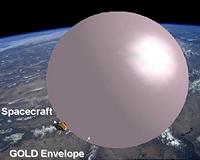 Safe And Efficient De-Orbit Of Space Junk Without Making The Problem Worse
Altadena CA (SPX) Aug 03, 2010 Global Aerospace Corporation (GAC) announced that Dr. Kristin L. Gates will present a paper on de-orbiting space junk at the August 2 Artificial and Natural Space Debris session of the AIAA Astrodynamics Specialists Conference in Toronto, Ontario, Canada. Dr. Gates will describe GAC's Gossamer Orbit Lowering Device (GOLD) for safe and efficient removal from Low Earth Orbit (LEO) of dangero ... read more |
|
|
| The content herein, unless otherwise known to be public domain, are Copyright 1995-2010 - SpaceDaily. AFP and UPI Wire Stories are copyright Agence France-Presse and United Press International. ESA Portal Reports are copyright European Space Agency. All NASA sourced material is public domain. Additional copyrights may apply in whole or part to other bona fide parties. Advertising does not imply endorsement,agreement or approval of any opinions, statements or information provided by SpaceDaily on any Web page published or hosted by SpaceDaily. Privacy Statement |


 del.icio.us
 Digg
Digg Reddit
 YahooMyWeb
 Google
 Facebook


