|
 |
 |
 |
 |
 |
 |
 |

| . |  |
. |

|
|
. |

 by Staff Writers Kourou, French Guiana (AFP) Oct 21, 2011
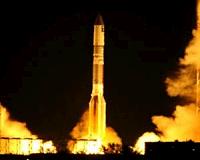
A Soyuz rocket lifted off on Friday on its maiden flight from Europe's space base here, carrying the first two satellites in the Galileo geopositioning system. The launch marked an unprecedented step in space cooperation, being the first by the veteran rocket beyond Russia's historic bases at Plesetsk and Baikonur. As mission controllers counted off the final seconds, Soyuz's main engines ignited, a cluster of umbilical masts flipped back and at 1030 GMT the rocket clawed its way skywards through a pounding tropical rain. After a nine-minute flight through Earth's atmosphere, its final stage, the Fregat, fired up to drive the satellites toward their orbital slots, a last leg that should take more than three hours. "The first part of this mission has gone well," said Jean-Yves Le Gall, chief executive of Arianespace, which markets launches at Kourou. Friday's launch came after a 24-hour postponement caused by a faulty valve in a ground system designed to disconnect fuel lines to the rocket's third stage just before flight. Soyuz is a space legend, for it traces its lineage to 1957 with Sputnik, the first satellite, and to the first manned flight, by Yuri Gagarin, in 1961. Friday's launch was the 1,777th in the Soyuz saga. It has a success rate of 94.4 percent. A symbol of national pride in Russia, the rocket was deployed at a specially-built pad at Kourou under a 2003 deal intended to complete Arianespace's marketing range. The contract gives the firm an off-the-shelf medium-range rocket alongside a heavy lifter, the Ariane 5, and a lightweight launcher, the Vega, due to make its maiden flight early next year. Arianespace says it has orders for 14 Soyuz launches from Kourou, including the third and fourth satellites in the Galileo constellation next year. Priced at 5.4 billion euros (7.2 billion dollars), Galileo is intended to give Europe independence in satellite navigation, a vital component of the 21st-century economy, from the US Global Positioning System (GPS). When completed in 2020, it will comprise 27 operational satellites and three spares and provide accuracy to within a metre (3.25 feet), compared to three to eight metres (10 and 26 feet) for the GPS, according to official websites. Galileo satellites will orbit at 23,200 kilometres (14,400 miles) in three orbital planes at a 56-degree angle to the Equator, providing coverage right up to the poles and improving reception in cities, where tall buildings can mask signals. According to the European Union's executive Commission, the market for geopositioning services will grow from 130 billion euros (180 billion dollars) in 2010 to 240 billion euros (330 billion dollars) in 2020. The Soyuz version launched at Kourou is different from the Soyuz U, which failed on August 24 while carrying a cargo ship to the International Space Station (ISS). That problem was traced to a failure on the Soyuz U's upper stage, which is not the same as the Fregat.
- Launch Pad at Space-Travel.com
|
. |
|
| The content herein, unless otherwise known to be public domain, are Copyright 1995-2011 - Space Media Network. AFP and UPI Wire Stories are copyright Agence France-Presse and United Press International. ESA Portal Reports are copyright European Space Agency. All NASA sourced material is public domain. Additional copyrights may apply in whole or part to other bona fide parties. Advertising does not imply endorsement,agreement or approval of any opinions, statements or information provided by Space Media Network on any Web page published or hosted by Space Media Network. Privacy Statement |

 del.icio.us
 Digg
Digg Reddit
 Google