|
 |
 |
 |
 |
 |
 |
 |
 |
 |

| . |  |
. |
SpaceX Performs First Rocket Engine Firings
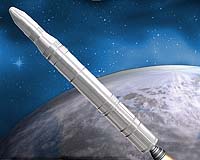
El Segundo - Mar 28, 2003 New rocket entrant SpaceX has announced the successful firing of the company's Falcon rocket main engine earlier this month. While drawing upon the ideas of many prior launch vehicle programs from Apollo to the X-34/Fastrac, SpaceX is privately developing the entire Falcon rocket from the ground up, including both engines, the turbo-pump, the cryogenic tank structure and the guidance system. A ground up internal development increases difficulty and the required investment, but no other path will achieve the needed improvement in the cost of access to space. "Satellites and spacecraft urgently need a more reliable and cost effective launch vehicle than the options available today. SpaceX is confident that our Falcon rocket will achieve that end in the near future," said Elon Musk, SpaceX Chairman and CEO. "In only nine months we've designed, built and initiated testing of our rocket's main engine, which is a testament to the capability and determination of the SpaceX team to deliver on promised goals in record time." "This is the most successful engine test program I have managed in more than 15 years of rocket engine development," said Tom Mueller, SpaceX Vice President of Propulsion and former head of liquid rocket propulsion development at TRW Space and Electronics(tm). "It is all the more exceptional given that the engine is a clean sheet design with several new technology innovations." In initial tests, the liquid oxygen and kerosene engine, named Merlin, achieved full expected thrust of 60,000 lbs and a combustion efficiency of 93%. With further testing, the company expects to exceed a 96% efficiency level. This compares well with the much larger Saturn V Moon rocket's F-1 engine, which used the same propellant combination, but achieved only 93.5% efficiency. Related Links Spacex SpaceDaily Search SpaceDaily Subscribe To SpaceDaily Express  The Universal Reusable First Stage: The Next 'Stage' In Space Transportation
  Washington - Mar 28, 2003
The Space Race of the 1960s did not allow the time needed to develop reusable Space transportation systems. The requirement to beat the Russians led to the development of expendable capsules: the Mercury, Gemini, and Apollo spacecraft. |
|
|

| The content herein, unless otherwise known to be public domain, are Copyright 1995-2006 - SpaceDaily.AFP and UPI Wire Stories are copyright Agence France-Presse and United Press International. ESA PortalReports are copyright European Space Agency. All NASA sourced material is public domain. Additionalcopyrights may apply in whole or part to other bona fide parties. Advertising does not imply endorsement,agreement or approval of any opinions, statements or information provided by SpaceDaily on any Web page published or hosted by SpaceDaily. Privacy Statement |