|
 |
 |
 |
 |
 |
 |
 |
 |
 |

| . |  |
. |
Space Mission Xeus Probes Origins Of The Universe
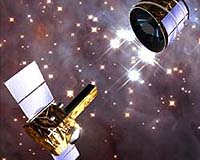
Leicester, UK (SPX) Nov 05, 2007 A University of Leicester astrophysicist is playing a pivotal role in a mission that seeks to study the origins of the universe. Professor Martin Turner of the Department of Physics and Astronomy is Co-Principal Investigator on XEUS - a next-generation X-ray space observatory. XEUS, which stands for X-ray Evolving Universe Spectroscopy, aims to study the fundamental laws of the Universe. With unprecedented sensitivity to the hot, million-degree universe, XEUS will explore key areas of contemporary astrophysics: growth of supermassive black holes, cosmic feedback and galaxy evolution, evolution of large-scale structures, extreme gravity and matter under extreme conditions, the dynamical evolution of cosmic plasmas and cosmic chemistry. Professor Turner is also Chair of the XEUS International Steering committee. He said: "XEUS is an X-ray observatory 30-50 times more sensitive than XMM-Newton, which will be placed 1.5 million km from Earth, beyond the Moon, at the second Lagrangian point, a quiet stable location where the instruments can observe the universe undisturbed. "Because it is so large, the observatory has two spacecraft. The five-metre diameter X-ray lens is in one, and the instruments in another. The two spacecraft fly together, 35 metres apart, to keep the instruments at the focus of the lens. "XEUS has been selected for study by ESA as part of its Cosmic Vision programme. If the study outcome is successful it will be launched on Ariane 5 from Kourou in 2018. "We have been developing the XEUS concept for an advanced X-ray observatory, for many years. This acceptance by ESA is a major step forward for X-ray astronomers all over the world." "The million degree universe, where gravity is the main source of energy, is the finest physics laboratory we have. XEUS will help us find out about the behaviour of matter under extreme conditions of temperature, pressure, and gravity. It will also let us study the influence of black holes on the formation of galaxies and stars; and ultimately planets and ourselves." Dr Richard Willingale, of the University of Leicester and chairman of the XEUS telescope working group said. "XEUS will use new lightweight silicon optics to make the lens, the same material used to make silicon chips; one of the instruments has sensors cooled to within a tiny fraction of absolute zero to study the chemistry and physics of matter surrounding black holes." Various international Space Agencies have expressed interest in cooperation in XEUS and discussions will start by the end of the year to ensure the earliest involvement in study work. All the candidate missions are now competing in an assessment cycle which ends in 2011. Before the end of the cycle, there will be an important selection foreseen in 2009. At the end of this process, two missions will be proposed for implementation to ESA's Science Programme Committee, with launches planned for 2017 and 2018 respectively. The selected missions fit well within the themes of ESA's Cosmic Vision 2015-2025 plan. The themes range from the conditions for life and planetary formation, to the origin and formation of the Solar System, the fundamental laws of our cosmos and the origin, structure and evolution of the Universe. "The maturity of most of the proposals received demonstrates the excellence of the scientific community in Europe. This made the task of the SSAC very difficult but we believe that the set of selected missions will shape the future of European space science," said Tilman Spohn, chairperson of the SSAC (German Aerospace Center, Berlin). "The next decade will indeed be very exciting for the scientific exploration of space." According to the chair of the Astronomy Working Group (AWG), Tommaso Maccacaro, (INAF - Osservatorio Astronomico di Brera) "The chosen candidates for astronomy missions show very promising and broad scientific return and have received excellent recommendations also from external referees." "Technical feasibility and potential for successful cooperation with other agencies are two factors which are clearly evident in the Solar System missions that have been chosen," added Nick Thomas at the Physikalisches Institut, Universit�t Bern, chair of the Solar System Working Group. Community Email This Article Comment On This Article Related Links University of Leicester Understanding Time and Space
 Senators warn Bush has no authority on Iran
 Washington (AFP) Nov 1, 2007
Thirty US senators wrote to President George W. Bush Thursday, warning he had no authority to launch military action against Iran, and expressing concern about the administration's "provocative" rhetoric. |
|
|

| The content herein, unless otherwise known to be public domain, are Copyright 1995-2006 - SpaceDaily.AFP and UPI Wire Stories are copyright Agence France-Presse and United Press International. ESA PortalReports are copyright European Space Agency. All NASA sourced material is public domain. Additionalcopyrights may apply in whole or part to other bona fide parties. Advertising does not imply endorsement,agreement or approval of any opinions, statements or information provided by SpaceDaily on any Web page published or hosted by SpaceDaily. Privacy Statement |