|
 |
 |
 |
 |
 |
 |
 |

| . |  |
. |

|
|
. |

 by Staff Writers Paris, France (ESA) Jul 22, 2011
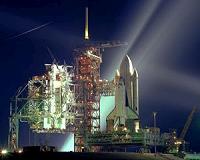
Thus was history made: Space Shuttle Atlantis left the International Space Station on Tuesday and made its last return to Earth. The Shuttle era is now over and the door is open to the next generation of space vehicles. After an additional day to accommodate the cargo movements to and from the Raffaello transport module, the STS-135 mission lasted 12 days 18 hours 27 minutes. The main wheels of Atlantis touched the runway at 11:56:58 CEST (09:56:58 GMT) in Florida. Along with four astronauts, the spaceplane brought back a precious load of biomedical samples. The Shuttle's retirement leaves Russia's smaller Soyuz craft as the only way to make return trips to the Station. The capacity for bringing down items is now very limited. Atlantis also returned with 2.5 tonnes of waste, hardware no longer needed and a faulty ammonia pump for investigation. Atlantis will now join the decommissioned vehicles of the Shuttle fleet, to be handed over to US museums. In this case, the trip will be a short one: Atlantis will be a major attraction at the Kennedy Space Center's nearby visitor complex. "This was the last flight of this fantastic vehicle, which was able to carry more than 20 tonnes to space and back," said Thomas Reiter, ESA's Director for Human Spaceflight and Operations and one of the 24 European astronauts to have flown on a Shuttle. "This is sad, but also we're looking into the future about the new things that will happen. "We will continue to operate the Station for the upcoming years, when we have to rely on the Russian Soyuz capsules for human transportation, but also the new transportation systems will soon come to the market."
related report When the space shuttle Atlantis landed at the Kennedy Space Center on 21 July 2011, a 30-year era came to an end. What will happen in the next chapter of German and international human spaceflight, following this pause? Space flight has outgrown the status of being a 'demonstration of power' that it had during the Cold War and become part of our everyday infrastructure, directly affecting areas such as weather and climate monitoring, navigation and communication. It is equally evident in human spaceflight, where experiments on the biological effects of weightlessness and the absence of the protective envelope of Earth's atmosphere can be performed. However, both manned and robotic spaceflight will continue to be part of mankind's efforts to further its knowledge and explore unknown worlds. The Russian Soyuz spacecraft are now the only means of transport available to carry astronauts to the International Space Station. Can they really replace the space shuttle? What particular challenges will arise for the next manned missions? Soyuz and the space shuttle have proven to be reliable transportation for cosmonauts and astronauts in recent decades. The shuttle was also capable of carrying larger payloads into orbit and bringing them back to Earth - this is a capability we will be lacking for the next few years. Unfortunately, the idea of adapting the ATV for this purpose, which was developed a few years ago, is not likely to be implemented in the near future, owing to the financial constraints on member states of the European Space Agency (ESA). We are now waiting to see what the Commercial Crew Development Program (CCDev2), the US initiative for commercial space flight, can achieve. The goal of this programme is to provide another means of transport for human spaceflight as soon as possible, following the last shuttle flight. The German Federal Government's space strategy focuses primarily on the benefits of space for people on Earth. How can manned missions continue to fulfil this requirement in view of the more limited transportation capability? For example, what role can experiments in microgravity involving astronauts play? Experiments in microgravity involving astronauts are certain to continue. The boundary conditions for this do not date from the pre-shuttle era. Besides the ISS, the ATV and HTV are available as means of transport, and the global space network offers additional options. However, the issue of bringing back equipment, experiments and samples needs to be resolved soon. Looking at international collaboration, are there serious plans, for example, to use the European Automated Transfer Vehicle (ATV), in which Germany has had a large involvement, to transport astronauts? The ATV is already used in human space flight. It transports food and other materials for the astronauts and automatically docks to the International Space Station, Hence it fulfils an important function for human spaceflight and addresses the specific safety requirements. But it is not designed for transporting people. Rather, we need to see whether cooperation between the United States and Europe, in particular, can lead to the implementation of new configurations when combining European and US technology and experience taking into account financial possibilities. There are plenty of ideas. What is your opinion regarding the privatisation and commercialisation of spaceflight? What commitment from private industry do you think is reasonable for future exploration missions? Privatisation and commercialisation are two different things. Private companies are already successful in the field of communication and are investing in space in a similar way to their earthbound infrastructure. In human spaceflight, some companies have opted for space tourism as a business model and are developing appropriate vehicles for flights at altitudes of over 100 kilometres. For commercial space transportation, Europe has established a 'prototype' with Arianespace, where an independent business receives government support, which is being used as a model by other countries. In the fields of science and exploration, the government will continue to play a key role in financing the space flight of the future.
|
. |
|
| The content herein, unless otherwise known to be public domain, are Copyright 1995-2011 - Space Media Network. AFP and UPI Wire Stories are copyright Agence France-Presse and United Press International. ESA Portal Reports are copyright European Space Agency. All NASA sourced material is public domain. Additional copyrights may apply in whole or part to other bona fide parties. Advertising does not imply endorsement,agreement or approval of any opinions, statements or information provided by Space Media Network on any Web page published or hosted by Space Media Network. Privacy Statement |

 del.icio.us
 Digg
Digg Reddit
 Google