Subscribe free to our newsletters via your
. Military Space News .


SPACE MEDICINE
Space bugs for blood testing and more
by Staff Writers
Paris, France (ESA) Aug 20, 2012


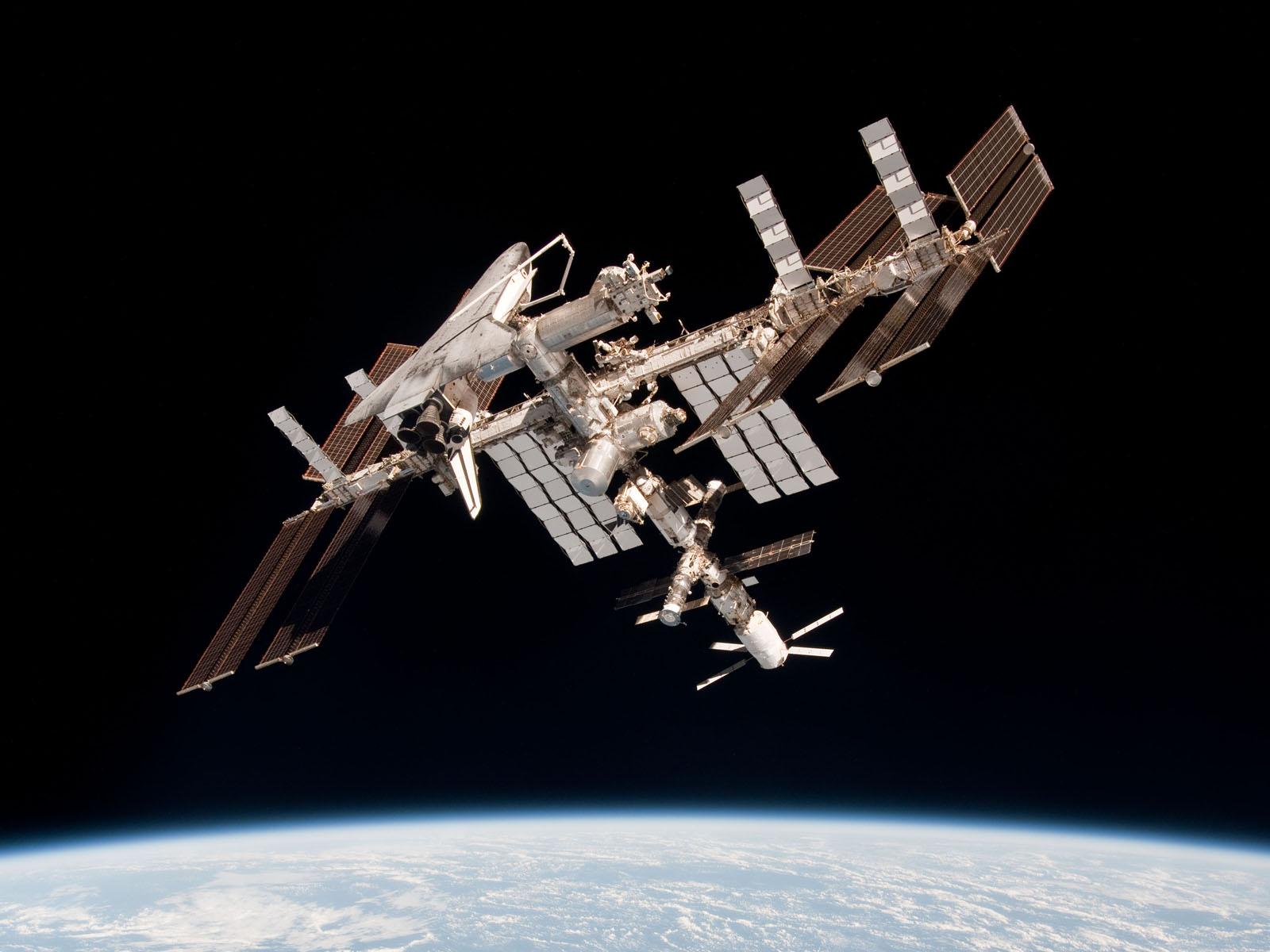
This image of the International Space Station with the docked Europe's ATV Johannes Kepler and Space Shuttle Endeavour was taken by ESA astronaut Paolo Nespoli from Soyuz TMA-20 following its undocking on 24 May 2011. The pictures are the first of a Shuttle docked to the Space Station from the perspective of a Russian Soyuz spacecraft. On the Soyuz were Russian cosmonaut and Expedition 27 commander Dmitry Kondratyev, ESA's Paolo Nespoli and NASA astronaut Cady Coleman. Paolo and Cady were both flight engineers. The three landed in Kazakhstan later that day, completing 159 days in space. Credits: ESA/NASA. For a larger version of this image please go here.

Thanks to ideas of putting swarms of tiny robot bugs to work on a future space station, patients being medicated for blood clots may soon get a simple, home-use testing kit, here on Earth. Fifteen years ago as a graduate student, Vladislav Djakov started building these micro-electromechanical creatures that mimic the swarms of bugs found in nature.

Equipped with a power supply, limited intelligence and monitoring systems, the bugs would be small enough to send en masse to hard-to-reach places, like pipes carrying liquids on space stations.

There, monitoring changes in temperature or flow could warn of impending malfunctions.

To move the bugs, the scientist hit on using cilia-like motion, much like some deep-sea creatures use to propel themselves. They covered one face of the microchip with tiny cantilever arms.

"They would then move along on these like millipedes," said Dr Djakov, now Director of Sensor Development at Microvisk Technologies.

In the end, the space bugs were ahead of their time: they haven't yet progressed past the testing phase.

But the cilia approach - the cantilever arms to propel the bugs - has gone further.

Space cantilevers spin off
STFC Innovation, ESA's Technology Transfer Programme partner that operates the agency's Business Incubation Centre Harwell in the UK, saw the business potential in the medical market and supported start-up company Microvisk to spin off the technology.

At Microvisk, Dr Djakov's team stripped down the microchips and put the intelligent sensing mechanisms right into the cantilever arms, almost like a cat's whiskers.

These whiskers turned out to be very good at monitoring liquids. Sweeping through, they note changes in viscosity and register if anything is suspended in the liquid.

"This is very interesting for probing blood, plasma, and other bodily fluids," said Dr Djakov.

At present, investors are betting on a device to monitor blood coagulation for patients taking blood thinner medication: "It's like a diabetes test, but for thrombosis."

Thanks to this coagulometer, the Microvisk CoagLite, patients will soon be able to test themselves at home with the prick of a finger.

After a small chamber inside the test strip fills with blood, the tiny cantilever sweeps the drop, monitoring how quickly it coagulates.

"You need less blood, which means there is less pain," said Dr Djakov, who compared its ease-of-use to diabetics' simple glucose monitors. "Haematologists are finding it really important."

Now undergoing clinical testing with US Food and Drug Administration, the coagulometer should be on the market later next year.

But the whisker technology isn't limited to testing blood.

"It would be good for things like plasma or teardrops," said Dr Djakov, "or to test the oil in a car engine, or in the food industry, to test chocolate or ketchup.

"There are literally hundreds of applications, for this innovation which started as a 'space bug'."

.


Related Links
Microvisk
ESA Harwell
UK Space Agency/
Space Medicine Technology and Systems


Comment on this article via your Facebook, Yahoo, AOL, Hotmail login.

Share this article via these popular social media networks
del.icio.usdel.icio.us DiggDigg RedditReddit GoogleGoogle


SPACE MEDICINE
NASA Selects Space Biology Research Proposals
Washington DC (SPX) Aug 14, 2012
NASA selected 15 experiments to be funded through its most recent research announcement for opportunities in space biology research. Ten of these experiments will be conducted aboard the International Space Station in the near future. Five others will be ground-based studies. NASA's Space Biology Program will fund the proposals to investigate how cells, plants and animals respond to microg ... read more


SPACE MEDICINE
Lockheed Martin Receives Contract To Produce THAAD Weapon System Equipment For The US Army

Israel wraps up national SMS missile alert test

Komorowski says Poland should have own missile shield

MEADS Multifunction Fire Control Radar Finishes Integration and Test Events At Italian Test Range

SPACE MEDICINE
Israel deploys anti-rocket battery near Egypt border: army

Thailand seeks Evolved SeaSparrow missiles

Iran says upgraded short-range missile test-fired

Raytheon awarded contract to produce new Rolling Airframe Missile

SPACE MEDICINE
US drones kill six militants in NW Pakistan: officials

US drone kills six militants in Pakistan: officials

Boeing Delivers Smaller, Lighter Radio Relay for Unmanned Aerial Vehicles

US Army certifies soldiers ready to defend battlespace with JLENS

SPACE MEDICINE
Raytheon unveils cross domain strategy to securely access information via mobile devices

NATO Special Forces Taps Mutualink for Global Cross Coalition Communications

Northrop Grumman Demonstrates Integrated Receiver Circuit Under DARPA Program

Boeing Receives 10th WGS Satellite Order from USAF

SPACE MEDICINE
Obama says use of Syrian chemical weapons 'red line'

Lockheed Martin Receives US Marine Corps Contract For Personnel Carrier Vehicle Study and Demonstration

Turkish defense market worth $14 billion

Burnt wreckage of two Ugandan army helicopters found

SPACE MEDICINE
Germany allows domestic military ops, ending taboo

EADS bosses told of questionable payments in 2007: FT

Sri Lanka eyes Mi-17 helicopters

Former Blackwater fined $7.5 mn over US arms case

SPACE MEDICINE
Japan stands firm on China islands dispute

Japan-China dispute: little islands, big problem

Bo Xilai: China's fallen political star

Americans back guns, even after shootings: poll

SPACE MEDICINE
New Phenomenon in Nanodisk Magnetic Vortices

Oh, my stars and hexagons! DNA code shapes gold nanoparticles

UCF nanoparticle discovery opens door for pharmaceuticals

New structural information on functionalization of gold nanoparticles


The content herein, unless otherwise known to be public domain, are Copyright 1995-2014 - Space Media Network. AFP, UPI and IANS news wire stories are copyright Agence France-Presse, United Press International and Indo-Asia News Service. ESA Portal Reports are copyright European Space Agency. All NASA sourced material is public domain. Additional copyrights may apply in whole or part to other bona fide parties. Advertising does not imply endorsement,agreement or approval of any opinions, statements or information provided by Space Media Network on any Web page published or hosted by Space Media Network. Privacy Statement