
 |
 |
 |
 |
 |
 |
 |
 |
 |
 |

| . |  |
. |

Potsdam, Geramny (SPX) Apr 28, 2011 From the analysis of the chemical composition of some of the oldest stars in our Galaxy, an international team of astronomers led by Cristina Chiappini from the Leibniz-Institut fuer Astrophysik Potsdam (AIP) and the Instituto Nazionale di Astrofisica (INAF) presents new clues on the nature of the first stellar generations in our Universe. "We think that the first generations of massive stars were very fast rotators - that's why we called them spinstars", explains Chiappini. Their findings will be published in a Nature article on April 28, 2011. Massive stars live fast and furious, and hence the first generations of massive stars in the Universe are already dead. However, their chemical imprints, like fingerprints, can still be found today in the oldest stars in our Galaxy. These fossil records are thus the witnesses of the nature of the first stellar generations to pollute our Universe. "It is like if we tried to reveal the character of a cook from the taste of his dishes", says Prof. Georges Meynet, from the Geneva University. How were these first stars? Were they different from the stars we observe today? Soon after the Big Bang, the composition of the Universe was much simpler than at present as it was made of essentially only hydrogen and helium. The chemical enrichment of the Universe with other elements had to wait around 300 million years until the fireworks started with the death of the first generations of massive stars, polluting the primordial gas with new chemical elements, which were later incorporated in the next generations of stars. Using data from ESO's Very Large Telescope (VLT), the astronomers reanalyzed spectra of a group of very old stars in the Galactic Bulge. These stars are so old that only very massive, short-living stars with masses larger than around ten times the mass of our Sun should have had time to die and to pollute the gas from which these fossil records then formed. As expected, the chemical composition of the observed stars showed elements typical for enrichment by massive stars. However, the new analysis unexpectedly also revealed elements usually thought to be produced only by stars of smaller masses. Fast-rotating massive stars on the other hand would succeed in manufacturing these elements themselves. "Alternative scenarios cannot yet be discarded - but - we show that if the first generations of massive stars were spinstars, this would offer a very elegant explanation to this puzzle!", says Cristina Chiappini. Team member Urs Frischknecht, a PhD student at the Basel University, is already working on extending the stellar simulations in order to further test the proposed scenario. The impact of having had an early generation of spinstars in the Universe is manifold. Fast rotation also affects other properties of a star, such as its color, its lifetime and its luminosity. Spinstars would therefore also have strongly influenced the properties and appearance of the first galaxies which were formed in the Universe. The existence of spinstars is now also supported by recent hydrodynamic simulations of the formation of the first stars of the universe by an independent research group.
Share This Article With Planet Earth
Related Links Leibniz-Institut fuer Astrophysik Potsdam (AIP) Stellar Chemistry, The Universe And All Within It

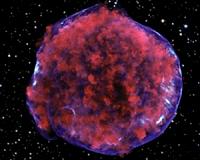 NASA's Chandra Finds New Evidence on Origin of Supernovas
Cambridge MA (SPX) Apr 27, 2011 Astronomers may now know the cause of an historic supernova explosion that is an important type of object for investigating dark energy in the universe. The discovery, made using NASA's Chandra X-ray Observatory, also provides strong evidence that a star can survive the explosive impact generated when a companion star goes supernova. The new study examined the remnant of a supernova observ ... read more |
|
|
| The content herein, unless otherwise known to be public domain, are Copyright 1995-2010 - SpaceDaily. AFP and UPI Wire Stories are copyright Agence France-Presse and United Press International. ESA Portal Reports are copyright European Space Agency. All NASA sourced material is public domain. Additional copyrights may apply in whole or part to other bona fide parties. Advertising does not imply endorsement,agreement or approval of any opinions, statements or information provided by SpaceDaily on any Web page published or hosted by SpaceDaily. Privacy Statement |


 del.icio.us
 Digg
Digg Reddit
 YahooMyWeb
 Google
 Facebook


