|
 |
 |
 |
 |
 |
 |
 |
 |
 |

| . |  |
. |
Spitzer Detects Organic Chemistry In Highly Luminous Galaxy
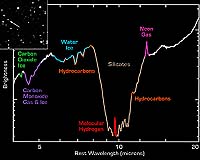
Ithaca - Dec 19, 2003 An instrument aboard NASA's recently launched orbiting infrared observatory has found evidence of organic molecules in an enormously powerful galaxy some 3.25 billion light years from the Earth. So powerful is the source, that it is equal to 10 trillion times the luminosity of the sun, making it one of the brightest galaxies ever detected. The instrument on the newly named Spitzer Space Telescope (previously called the Space Infrared Telescope Facility, or SIRTF) is the infrared spectrograph, or IRS. James Houck, professor of astronomy at Cornell University, heads the scientific team on the $39 million IRS contract with the Jet Propulsion Laboratory, Pasadena, Calif., a division of the California Institute of Technology, manager of the mission for NASA. Houck participated in a press conference at NASA headquarters in Washington, D.C., today (Dec. 18) at which the first observations and data from the half-billion-dollar observatory, launched Aug. 25, were released. Among the most spectacular details released were dazzling images taken with the space telescope's infrared-array camera and with its multiband-imaging photometer. The images include a glowing stellar nursery; a swirling, dusty galaxy; a disc of planet-forming debris; and organic material in the distant universe. The IRS, one of three instruments carried by the space telescope, is the most sensitive infrared spectrograph ever to go into space. In less than 15 minutes it produced a spectrum of the distant galaxy IRAS 00183, first observed by the infrared astronomical satellite (IRAS) in 1983. The spectrum "gives evidence for organic chemistry in a distant galaxy shortly after the formation of the Earth," says Houck. (While the Spitzer observatory's cameras take infrared snapshots of distant galaxies and dust clouds, and objects too cool to emit visible light, the IRS determines their precise infrared colors. Astronomers are then able to read the peaks and valleys in the spectrum, called emission and absorption lines, to determine the chemical mix of the object being observed.) In an optical image, the IRAS galaxy appears as no more than a faint smudge. But the IRS spectrum - the first detailed look at the galaxy - shows a broad silicate feature. The dominant absorber of visible energy is tiny silicate dust particles. The silicate dust is so opaque that only a small percentage of the visible light escapes the galaxy, says Houck. "We are seeing the merger of two galaxies. This produces one of two effects: Either what we are seeing is a brief flash of incredibly strong star formation, or one or both of the galaxies contained a black hole before colliding. The massive black holes are releasing the energy by swallowing stars and gas," says Houck. In both cases, he says, the collision would compress gas that would trigger the star formation or the release of energy from the black hole, a process called "feeding the monster." Both scenarios have problems, Houck concedes. "One is, how do you get enough gas close enough to a black hole to make all this happen? And how do you get stars to form so quickly all at the same time?" Houck's IRS team also released a spectrum of HH46IR, a "dusty, dirty cloud" in our galaxy, the Milky Way, that visible light is unable to penetrate. The spectrum shows the cloud to be a region of star formation containing organic materials, including methyl alcohol, carbon dioxide ice and carbon monoxide gas and ice. Houck also notes that the IRS is "working well" and is likely to be "a workhorse for years to come." During November, he relates, the instrument was subject to a massive proton "storm" in space, with 1.6 billion atomic particles (mostly protons) bombarding a square centimeter of the instrument in just two days. "It was a staggering event," he says. Related Links Spitzer Space Telescope at JPL SpaceDaily Search SpaceDaily Subscribe To SpaceDaily Express  Satellite Sees Through Space Clouds
 Boston - Dec 19, 2003
Heart pounding, nerves strung tight, Giovanni Fazio fixed his eyes on the rocket about to be launched. Sitting on top of it was his whole life's work, a camera that could look beyond the visible universe to see planets, stars, and galaxies being born. |
|
|

| The content herein, unless otherwise known to be public domain, are Copyright 1995-2006 - SpaceDaily.AFP and UPI Wire Stories are copyright Agence France-Presse and United Press International. ESA PortalReports are copyright European Space Agency. All NASA sourced material is public domain. Additionalcopyrights may apply in whole or part to other bona fide parties. Advertising does not imply endorsement,agreement or approval of any opinions, statements or information provided by SpaceDaily on any Web page published or hosted by SpaceDaily. Privacy Statement |