|
 |
 |
 |
 |
 |
 |
 |
 |
 |

| . |  |
. |
Spitzer Searches For The Origins Of Life
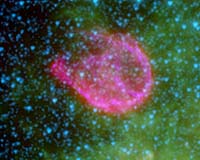
for Spitzer Science Center Pasadena CA (JPL) Jun 18, 2007 Astronomers suspect the early Earth was a very harsh place. Temperatures were extreme, and the planet was constantly bombarded by cosmic debris. Many scientists believe that life's starting materials, or building blocks, must have been very resilient to have survived this tumultuous environment. Now, NASA's Spitzer Space Telescope has learned that organic molecules believed to be among life's building blocks, called polycyclic aromatic hydrocarbons, can also survive the harsh environment of an exploding supernova. Supernovae are the violent deaths of the most massive stars. In death, these volatile objects blast tons of energetic waves into the cosmos, destroying much of the dust surrounding them. The fact that polycyclic aromatic hydrocarbons can survive a supernova indicates that they are incredibly tough - like cosmic cockroaches enduring a nuclear blast. Such durability might be further proof that these molecules are indeed among life's building blocks. Achim Tappe of the Harvard-Smithsonian Center for Astrophysics, Cambridge, Mass., used Spitzer's infrared spectrograph instrument to detect abundant amounts of polycyclic aromatic hydrocarbons along the ridge of supernova remnant N132D. The remnant is located 163,000 light-years away in a neighboring galaxy called, the Large Magellanic Cloud. "The fact that we see polycyclic aromatic hydrocarbons surviving this explosion illustrates their resilience," says Tappe. These intriguing molecules are comprised of carbon and hydrogen atoms, and have been spotted inside comets, around star-forming regions and planet-forming disks. Since all life on Earth is carbon based, astronomers suspect that some of Earth's original carbon might have come from these molecules - possibly from comets that smacked into the young planet. Astronomers say there is some evidence that a massive star exploded near our solar system as it was just beginning to form almost 5 billion years ago. If so, the polycyclic aromatic hydrocarbons that survived that blast might have helped seed life on our planet. Tappe's paper was published in the December 10, 2006, issue of Astrophysical Journal. Community Email This Article Comment On This Article Related Links Spitzer Space Telescope Harvard-Smithsonian Center for Astrophysics Life Beyond Earth Lands Beyond Beyond - extra solar planets - news and science
 Scientists Ponder Plant Life On Extrasolar Earthlike Planets
 St Louis MO (SPX) Jun 20, 2007
When we think of extrasolar Earth-like planets, the first tendency is to imagine weird creatures like Jar Jar Binks, Chewbacca, and, if those are not bizarre enough, maybe even the pointy-eared Vulcan, Spock, of Star Trek fame. But scientists seeking clues to life on extrasolar planets are studying various biosignatures found in the light spectrum leaking out to Earth to speculate on something more basic and essential than the musical expertise of Droopy McCool. |
|
|

| The content herein, unless otherwise known to be public domain, are Copyright 1995-2006 - SpaceDaily.AFP and UPI Wire Stories are copyright Agence France-Presse and United Press International. ESA PortalReports are copyright European Space Agency. All NASA sourced material is public domain. Additionalcopyrights may apply in whole or part to other bona fide parties. Advertising does not imply endorsement,agreement or approval of any opinions, statements or information provided by SpaceDaily on any Web page published or hosted by SpaceDaily. Privacy Statement |