|
 |
 |
 |
 |
 |
 |
 |
 |
 |

| . |  |
. |
Spreading Viruses As We Breathe
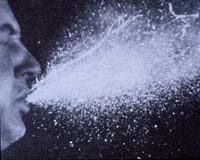
Brisbane, Australia (SPX) May 16, 2007 Keeping at arm's length won't protect you from catching an infectious disease, according to new research by Queensland University of Technology which reveals airborne viruses can spread far and wide. Professor Lidia Morawska, director of QUT's International Laboratory for Air Quality and Health, said the study dispelled the myth that viruses emitted from humans only travel a metre in the air. Professor Morawska and a team of QUT scientists have been studying the way droplets carring viruses are dispersed in the air when people speak, cough, sneeze and breathe. "The current belief is that if you are an arm's length away from someone you are protected from any viruses they might be carrying," she said. "When we talk about infection spread we are talking about droplets emitted from humans being dispersed in the air." As part of the study QUT designed and built a machine to measure the distance a droplet travels in the air prior to drying. "This droplet could potentially be carrying a virus," she said. "The significant part of our research has found that rather than the droplet falling directly to the ground after leaving the mouth, the liquid component of the droplet dries in the air and the dry residue travels large distances. "When a droplet dries in the air the residue is carried in the air, and therefore there is a risk that people can inhale that air and become infected." Professor Morawska said a droplet drying on a surface could be infectious but the greater danger was droplets drying in the air. "A droplet can travel for 10cm before it dries in the air, it doesn't immediately fall to the ground." She said the study, funded by the Australian Research Council, was motivated by an outbreak of SARS in Hong Kong where more than 300 people were infected within the space of a few hours. "We wanted to know how this virus was able to travel from building to building in such a short time," she said. Professor Morawska said her research had shown that one person infected with the disease could easily spread the virus by simply breathing. "Understanding the way viruses spread from human expiration means we can look to better design spaces, ventilation systems and filters," she said. Professor Morawska said the next stage of the research would investigate the global effect of dried droplets in health care facilities to see how viruses were spread around the world. Email This Article
Related Links  Boston (UPI) May 09, 2007
Scientists are zeroing in on discovering vaccines to control malaria, tuberculosis and HIV in poorer nations, say health experts involved in the effort. The diseases kill more than 6 million people each year and impact hundreds of millions of lives, many of them children in Latin America, Africa, Asia and Eastern Europe, Tadataka Yamada, president of the Bill and Melinda Gates Foundation, told United Press International. |
|
|

| The content herein, unless otherwise known to be public domain, are Copyright 1995-2006 - SpaceDaily.AFP and UPI Wire Stories are copyright Agence France-Presse and United Press International. ESA PortalReports are copyright European Space Agency. All NASA sourced material is public domain. Additionalcopyrights may apply in whole or part to other bona fide parties. Advertising does not imply endorsement,agreement or approval of any opinions, statements or information provided by SpaceDaily on any Web page published or hosted by SpaceDaily. Privacy Statement |