
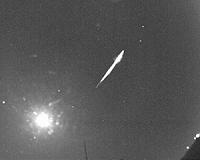
 A NASA fireball camera at the Marshall Space Flight Center. Please go here to view a movie of a spring fireball recorded by a NASA all-sky camera located at the Marshall Space Flight Center on March 16, 2009. |
"Spring is fireball season," says Bill Cooke of NASA's Meteoroid Environment Center. "For reasons we don't fully understand, the rate of bright meteors climbs during the weeks around the vernal equinox."
In other seasons, a person willing to watch the sky from dusk to dawn could expect to see around 10 random or "sporadic" fireballs. A fireball is a meteor brighter than the planet Venus. Earth is bombarded by them as our planet plows through the jetsam and flotsam of space--i.e., fragments of broken asteroids and decaying comets that litter the inner solar system.
In spring, fireballs are more abundant. Their nightly rate mysteriously climbs 10% to 30%.
"We've known about this phenomenon for more than 30 years," says Cooke. "It's not only fireballs that are affected. Meteorite falls--space rocks that actually hit the ground--are more common in spring as well1."
Researchers who study Earth's meteoroid environment have never come up with a satisfactory explanation for the extra fireballs. In fact, the more they think about it, the stranger it gets.
Consider the following:
There is a point in the heavens called the "apex of Earth's way." It is, simply, the direction our planet is traveling. As Earth circles the sun, the apex circles the heavens, completing one trip through the Zodiac every year.
The apex is significant because it is where sporadic meteors are supposed to come from. If Earth were a car, the apex would be the front windshield. When a car drives down a country road, insects accumulate on the glass up front. Ditto for meteoroids swept up by Earth.
Every autumn, the apex climbs to its highest point in the night sky. At that time, sporadic meteors of ordinary brightness are seen in abundance, sometimes dozens per night.
Read that again: Every autumn.
"Autumn is the season for sporadic meteors," says Cooke. "So why are the sporadic fireballs peaking in spring? That is the mystery."
Meteoroid expert Peter Brown of the University of Western Ontario notes that "some researchers think there might be an intrinsic variation in the meteoroid population along Earth's orbit, with a peak in big fireball-producing debris around spring and early summer. We probably won't know the answer until we learn more about their orbits2."
To solve this and other puzzles, Cooke is setting up a network of smart meteor cameras around the country to photograph fireballs and triangulate their orbits. As explained in the Science@NASA story What's Hitting Earth?, he's looking for places to put his cameras; educators are encouraged to get involved. Networked observations of spring fireballs could ultimately reveal their origin.
"It might take a few years to collect enough data," he cautions.
Until then, it's a beautiful mystery. Go out and enjoy the night sky. It is spring, after all.
 del.icio.us del.icio.us |
 Digg Digg |
 Reddit Reddit |
 YahooMyWeb YahooMyWeb |
 Google Google |
 Facebook Facebook |

 What's Hitting Earth
| The content herein, unless otherwise known to be public domain, are Copyright 1995-2010 - SpaceDaily. AFP and UPI Wire Stories are copyright Agence France-Presse and United Press International. ESA Portal Reports are copyright European Space Agency. All NASA sourced material is public domain. Additional copyrights may apply in whole or part to other bona fide parties. Advertising does not imply endorsement,agreement or approval of any opinions, statements or information provided by SpaceDaily on any Web page published or hosted by SpaceDaily. Privacy Statement |


