|
 |
 |
 |
 |
 |
 |
 |

| . |  |
. |

|
|
. |

 by Staff Writers Washington (AFP) June 16, 2011
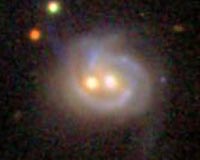
A bright gamma-ray flash seen in March came from a distant galaxy nearly four billion light years away where a Sun-sized star was being eaten by a black hole, US astronomers said Thursday. The energy from the cataclysmic blast is still being observed two and a half months later, said the study published in the journal Science. "This is truly different from any explosive event we have seen before," said lead author Joshua Bloom of the University of California at Berkeley. The flash in the constellation Draco was glimpsed March 28 by NASA's Swift satellite, which is on a mission to unravel the mysteries of powerful explosions in the universe known as gamma-ray bursts. A few days later, Bloom sent an email to colleagues "suggesting that it wasn't a typical gamma-ray burst at all," said the report. A closer look at the satellite data combined with other observations from the Hubble Space Telescope and the Chandra X-ray Observatory have confirmed that. It turns out that a star about the same size as the sun was being devoured 3.8 billion light years away. "We think this event was detected around the time it was as bright as it will ever be, and if it's really a star being ripped apart by a massive black hole, we predict that it will never happen again in this galaxy," he said. The energy from the gamma-ray flare, called Sw 1644+57 and which likely began on March 24 or 25, is still being emitted, but is expected to slowly fade over the course of the next year. "This burst produced a tremendous amount of energy over a fairly long period of time, and the event is still going on more than two and a half months later," said Bloom. "That's because as the black hole rips the star apart, the mass swirls around like water going down a drain, and this swirling process releases a lot of energy." The entire event may have been set off by a star that just ventured too close to a black hole at the center of the galaxy. "Here, you have a black hole sitting quiescently, not gobbling up matter, and all of a sudden something sets it off," Bloom said. "This could happen in our own galaxy, where a black hole sits at the center living in quiescence, and occasionally burbles or hiccups as it swallows a little bit of gas. From a distance, it would appear dormant, until a star randomly wanders too close and is shredded."
|
. |
|
| The content herein, unless otherwise known to be public domain, are Copyright 1995-2011 - Space Media Network. AFP and UPI Wire Stories are copyright Agence France-Presse and United Press International. ESA Portal Reports are copyright European Space Agency. All NASA sourced material is public domain. Additional copyrights may apply in whole or part to other bona fide parties. Advertising does not imply endorsement,agreement or approval of any opinions, statements or information provided by Space Media Network on any Web page published or hosted by Space Media Network. Privacy Statement |

 del.icio.us
 Digg
Digg Reddit
 Google