
 |
 |
 |
 |
 |
 |
 |
 |
 |
 |

| . |  |
. |
Stardust Logs A Decade Under The Stars
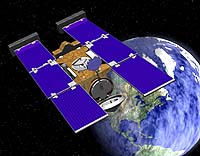
Pasadena CA (SPX) Feb 09, 2009 Saturday, Feb. 7, marked the 10th anniversary of the launch of NASA's well-traveled Stardust spacecraft. Launched on Feb. 7, 1999, Stardust , covered 3-billion-miles during its first seven years in space before returning the world's first samples from a known comet. Stardust's tennis racket-like, aerogel-lined collector was extended to capture particles hurtling at it at about six times the speed of a rifle bullet, as the spacecraft flew within 240 kilometers (149 miles) of comet Wild 2 in January 2004. The return capsule landed Jan. 15, 2006, in Utah, carrying both interstellar and comet particles, completing the first U.S. space mission to return extraterrestrial material from beyond the orbit of Mars. Two days later the capsule was transported to a curatorial facility at NASA's Johnson Space Center in Houston. With its prime mission complete, NASA re-designated the Stardust mission as Stardust-NExT. Short for Stardust-New Exploration of Tempel, Stardust-NExT is a low-cost, Discovery Program mission of opportunity that will expand the investigation of comet Tempel 1 initiated by NASA's Deep Impact spacecraft. The extended mission tasks the Stardust spacecraft to fly by the comet Tempel 1 on Feb. 14, 2011. During the flyby, it will obtain high-resolution images of the comet's coma and nucleus, as well as measurements of the composition, size distribution, and flux of dust emitted into the coma. Mission planners hope Stardust-NExT will provide important new information on how Jupiter-family comets evolve and how they formed 4.6 billion years ago. The Jet Propulsion Laboratory, a division of the California Institute of Technology, Pasadena, manages Stardust-NExT for the NASA Science Mission Directorate, Washington, D.C. Joseph Veverka of Cornell University, Ithaca, N.Y., is the mission's principal investigator. Lockheed Martin Space Systems, Denver, manages day-to-day mission operations. While the Stardust spacecraft is unavailable for public viewing at present (it is more than 13.5 million kilometers, or 8.4 million miles, from Earth), the public can view its sample return capsule. In Jan. 2006, the capsule became the fastest manmade object ever to enter Earth's atmosphere at over 46,400 kilometers per hour (28,800 mph). The capsule is on display at the National Air and Space Museum's Milestones of Flight Gallery in Washington. Share This Article With Planet Earth
Related Links Stardust Asteroid and Comet Mission News, Science and Technology
 Green Comet Approaches Earth
 Huntsville AL (SPX) Feb 05, 2009
In 1996, a 7-year-old boy in China bent over the eyepiece of a small telescope and saw something that would change his life--a comet of flamboyant beauty, bright and puffy with an active tail. At first he thought he himself had discovered it, but no, he learned, two men named "Hale" and "Bopp" had beat him to it. |
|
|

| The content herein, unless otherwise known to be public domain, are Copyright 1995-2007 - SpaceDaily.AFP and UPI Wire Stories are copyright Agence France-Presse and United Press International. ESA Portal Reports are copyright European Space Agency. All NASA sourced material is public domain. Additional copyrights may apply in whole or part to other bona fide parties. Advertising does not imply endorsement,agreement or approval of any opinions, statements or information provided by SpaceDaily on any Web page published or hosted by SpaceDaily. Privacy Statement |
 del.icio.us
 Digg
Digg Reddit
 YahooMyWeb
 Google
 Facebook