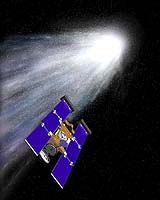
illustration only
illustration only |
As usual, the reliable spacecraft responded to our commands and the signal was received at the expected time. There was concern that a large solar flare last December could have placed the spacecraft in an unknown state.
The first telemetry indicated a processor reboot had occurred but the spacecraft's subsystems were in excellent condition. After restoring communication, the remainder of the Deep Space Network (DSN) pass was used to obtain the history data for the last year.
After saying "bon voyage" on January 29, 2006, the spacecraft passed through its perihelion (0.92 AU), the closest approach to the sun for the spacecraft, and made it safely through.
On July 10, 2006, a spontaneous reboot of the processor occurred. The cause of the reboot is unknown but was probably due to solar/space interference. The spacecraft returned itself to its safe mode state and continued
The spacecraft returned itself to its safe mode state and continued cruising. On December 7, 2006, another large solar flare created problems for the Star Camera.
After struggling for several hours to obtain good star images, an attitude control error caused the spacecraft to re-enter safe mode. Once again the spacecraft returned to its nominal safe mode state where it remained until contacted last Monday.
Our second DSN pass was used to clear the reboot counters, exit safe mode and ready the spacecraft for the instrument checkout scheduled. We will check out the health of the instrument suite including, Dust Flux Monitor (DFM), Cometary Interstellar Dust Analyzer (CIDA) and Navigation Camera (NAVCAM).
The playback of the science instruments will take the remaining DSN passes through early February. After all the recorded data has been received on the ground we will again command the spacecraft into its safe mode or hibernation state. The spacecraft will remain in hibernation until the final decision is made concerning the Stardust-NExT follow-on mission.
The Stardust-NExT (New Exploration of Tempel) mission would encounter the comet Tempel 1 in 2011 and image the crater made by the Deep Impact mission. The program is currently developing a Concept Study Report that provides additional information about the proposed follow-on mission. The final decision is expected in the May/June timeframe.
Related Links
 High-Energy Relic Wind Reveals Past Behavior Of Dead Stars
 Palo Alto CA (SPX) Feb 07, 2007
| The content herein, unless otherwise known to be public domain, are Copyright 1995-2006 - SpaceDaily.AFP and UPI Wire Stories are copyright Agence France-Presse and United Press International. ESA PortalReports are copyright European Space Agency. All NASA sourced material is public domain. Additionalcopyrights may apply in whole or part to other bona fide parties. Advertising does not imply endorsement,agreement or approval of any opinions, statements or information provided by SpaceDaily on any Web page published or hosted by SpaceDaily. Privacy Statement |