
 |
 |
 |
 |
 |
 |
 |
 |
 |
 |

| . |  |
. |
Stars Cheek By Jowl In The Early Universe
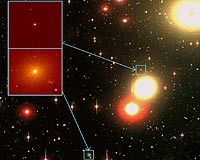
London, UK (SPX) Feb 13, 2009 In our Galaxy, we are used to the idea that even the nearest stars are light years away from the Sun. But a team of scientists led by Professor Pavel Kroupa of the University of Bonn think things were very different in the early Universe. In particular, Ultra Compact Dwarf galaxies (UCDs), a recently discovered class of object, may have had stars packed together a thousand times more closely than in the solar neighbourhood, according to calculations made by team member and PhD student Joerg Dabringhausen and presented in a paper in Monthly Notices of the Royal Astronomical Society. UCDs were discovered in 1999. Although they are still enormous by everyday standards, at about 60 light years across, they are less than 1/1000th the diameter of our own Galaxy, the Milky Way. (In more familiar units, a light year is about 10 million million km). Astronomers believe that UCDs were created when more normal galaxies collided in the early Universe. But oddly, UCDs clearly have more mass than the light from the stars they contain would imply. Up to now, exotic dark matter has been suggested to explain this 'missing mass', but this is not thought to gather in sufficient quantities within a UCD. In their paper Mr Dabringhausen, Professor Kroupa and their colleague Dr Holger Baumgardt present a different explanation. The astronomers think that at one time, each UCD had an incredibly high density of stars, with perhaps 1 million in each cubic light year of space, compared with the 1 that we see in the region of space around the Sun. These stars would have been close enough to merge from time to time, creating many much more massive stars in their place. These more massive stars consume hydrogen (their nuclear fuel) much more rapidly, before ending their lives in violent supernova explosions. All that then remains is either a superdense neutron star or sometimes a black hole. So in today's UCDs, a good part of their mass is made up of these dark remnants, largely invisible to Earth-based telescopes but fossils of a more dramatic past. Mr Dabringhausen comments, "Billions of years ago, UCDs must have been extraordinary. To have such a vast number of stars packed closely together is quite unlike anything we see today. An observer on a (hypothetical) planet inside a UCD would have seen a night sky as bright as day on Earth." Share This Article With Planet Earth
Related Links University of Bonn Royal Astronomical Society (RAS) Stellar Chemistry, The Universe And All Within It
 First Lab Experiment To Accurately Model Stellar Jets Explains Mysterious Knots
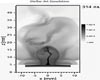 Rochester NY (SPX) Feb 11, 2009
Some of the most breathtaking objects in the cosmos are the jets of matter streaming out of stars, but astrophysicists have long been at a loss to explain how these jets achieve their varied shapes. Now, laboratory research detailed in the current issue of Astrophysical Review Letters shows how magnetic forces shape these stellar jets. |
|
|

| The content herein, unless otherwise known to be public domain, are Copyright 1995-2007 - SpaceDaily.AFP and UPI Wire Stories are copyright Agence France-Presse and United Press International. ESA Portal Reports are copyright European Space Agency. All NASA sourced material is public domain. Additional copyrights may apply in whole or part to other bona fide parties. Advertising does not imply endorsement,agreement or approval of any opinions, statements or information provided by SpaceDaily on any Web page published or hosted by SpaceDaily. Privacy Statement |
 del.icio.us
 Digg
Digg Reddit
 YahooMyWeb
 Google
 Facebook
