|
 |
 |
 |
 |
 |
 |
 |
 |
 |

| . |  |
. |
Stellar Destruction Made Sol's Future Bright
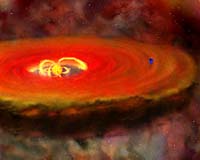
Washington DC (SPX) - May 11, 2005 Earth's early existence was likely a time of uncertain survival. Forming in a hostile environment, the Earth and neighboring developing planets had to compete for materials and steer clear of the ravenous Sun. But scientists with NASA's Chandra X-ray Observatory believe help in forming the Solar System may have come from a menacing and unlikely source: the Sun's own X-ray super-flares. "Big X-ray flares might lead to planetary systems like ours," said Eric Feigelson, a principal investigator for the science team using Chandra to study the phenomena. One way to gauge the Sun's influence is to blast to the past by looking at younger stars in the constellation Orion. "We don't have a time machine to see how the young Sun behaved, but the next best thing is to observe Sun-like stars in Orion," said Scott Wolk of the Harvard-Smithsonian Center for Astrophysics in Cambridge, Mass. "We are getting a unique look at stars between one and 10 million years old � a time when planets form." Young stars are surrounded by a debris field called a "planet-forming disk." As planets take shape within the disk, wakes form that push them toward and away from the star. The shove toward the star tends to be strongest, causing the planets to move perilously closer to it. The deciding factor appears to be the size of the star's X-ray flares. "Stars with smaller flares...might end up with 'hot jupiters,' or simply with no giant planets because they plummet into the star," Feigelson said. Hot jupiters are scorched, oversized planets orbiting near a star. Chandra scientists believe the threat diminishes when the disk is struck by large X-ray flares. The lashing electrically charges the disk and combines with other factors to produce incredible turbulence. "Although these flares may be creating havoc in the disks, they ultimately could do more good than harm," said Feigelson. "These flares may be acting like a planetary protection program." Choppy stellar waters jostle the budding planets. The buffeting forces the planets to haphazardly waddle around the disk in a "random walk" and avoid falling into the star. Scientists also suspect this walkabout allows planets to safely wander the disk, collecting more material and grow larger. The end result is the increased possibility young planets can mature into something like those in our Solar System. In times of danger, it's good to separate friend from foe. In the case of the Earth and Solar System, the Sun appears to have been both. The burning star not only served as a planet's biggest threat to survival, but also its greatest promise of a future. Related Links Orion at Harvard Chandra at Harvard SpaceDaily Search SpaceDaily Subscribe To SpaceDaily Express  In The Stars: The Message In The Photons
 Washington DC (UPI) - May 11, 2005
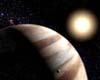
Humanity is decades, perhaps even centuries, away from directly exploring even the nearest solar systems, but astronomers already are compiling incredibly detailed information from very distant objects. |
|
|

| The content herein, unless otherwise known to be public domain, are Copyright 1995-2006 - SpaceDaily.AFP and UPI Wire Stories are copyright Agence France-Presse and United Press International. ESA PortalReports are copyright European Space Agency. All NASA sourced material is public domain. Additionalcopyrights may apply in whole or part to other bona fide parties. Advertising does not imply endorsement,agreement or approval of any opinions, statements or information provided by SpaceDaily on any Web page published or hosted by SpaceDaily. Privacy Statement |