
 |
 |
 |
 |
 |
 |
 |
 |
 |
 |

| . |  |
. |
Stellar Still Births
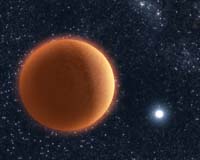
Bonn, Germany (SPX) Oct 03, 2008 The systematics of celestial bodies apparently needs to be revised. Researchers at the Argelander Institute of Astronomy of the University of Bonn have discovered that brown dwarfs need to be treated as a separate class in addition to stars and planets. To date they had been merely regarded as stars which were below normal size. However, they may well be stellar 'miscarriages'. The astronomers are publishing their results in the journal Monthly Notices of the Royal Astronomical Society. Brown dwarfs (or BDs) are what scientists call objects which populate the galaxies apart from the stars. Unlike the latter, they cannot develop high-yield hydrogen fusion as in the interior of our sun due to their low mass (less than about 8% of the sun's mass). But in addition to this brown dwarfs and stars also seem to be different in their 'mating behaviour'. Stars often occur in pairs, which dance around each other. The intimacy which this dance involves, however, varies a great deal: sometimes the gap is smaller than one radius of the Earth's orbit (also known as Astronomical Unit or AU). However, the two partners can also keep apart by as much as many thousands of AUs. 'Things are different with brown dwarfs,' astrophysicist Ingo Thies of the Bonn Argelander Institute of Astronomy explains. 'The orbital radiuses of BD pairs are cut off above about 15 AUs; BD pairs with greater distances are the exception.' What is more, there are hardly any mixed pairs consisting of suns and brown dwarfs - far fewer than expected. This phenomenon is also known as brown dwarf desert. 'According to the classical model there ought not to be these differences,' Professor Pavel Kroupa of the Argelander Institute explains. 'According to this both brown dwarfs and stars ought to emerge from interstellar clouds of gas which become concentrated because of the attraction of their mass. But if this was the case, these celestial bodies should behave in similar ways.' Despite this contradiction the astronomic community has previously stuck to the theory of a joint origin. However, Ingo Thies and Pavel Kroupa have now shown empirically for the first time that brown dwarfs must be seen as a class of objects which is separate from the stars. 'For this we analysed the masses of newly born stars,' Ingo Thies explains. 'This revealed a jump in the distribution of mass which makes the division in the stellar population apparent.'
Death of an embryonic star The physical mechanism itself has long been known: even the US light space probes Pioneer and Voyager were hurled off onto their voyage of no return by the planet's gravity. Another possibility would be that brown dwarfs form in the outermost regions of emergent stars and become separated from them. This can, for example, occur as the result of a close encounter with a third star. Since almost all stars are born in star clusters, such encounters are not unusual. It is also possible that both scenarios of cosmic miscarriages take place. Both theories predict that brown dwarfs can only emerge at the birth of stars - similar to the situation with planets, incidentally. Thus there are presumably three quite different celestial bodies: planets, brown dwarfs and stars. Community Email This Article Comment On This Article Share This Article With Planet Earth
Related Links Argelander Institute of Astronomy University of Bonn Stellar Chemistry, The Universe And All Within It
 Infrared Echoes Give NASA's Spitzer A Supernova Flashback
 Greenbelt MD (SPX) Oct 02, 2008
Hot spots near the shattered remains of an exploded star are echoing the blast's first moments, say scientists using data from NASA's Spitzer Space Telescope. |
|
|

| The content herein, unless otherwise known to be public domain, are Copyright 1995-2007 - SpaceDaily.AFP and UPI Wire Stories are copyright Agence France-Presse and United Press International. ESA Portal Reports are copyright European Space Agency. All NASA sourced material is public domain. Additional copyrights may apply in whole or part to other bona fide parties. Advertising does not imply endorsement,agreement or approval of any opinions, statements or information provided by SpaceDaily on any Web page published or hosted by SpaceDaily. Privacy Statement |
 del.icio.us
 Digg
Digg Reddit
 YahooMyWeb
 Google
 Facebook