|
 |
 |
 |
 |
 |
 |
 |
 |
 |

| . |  |
. |
Steppin' Out From Shenzhou
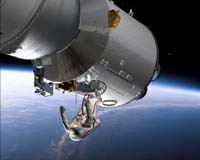
Geelong, Australia (SPX) Nov 08, 2006 China is drawing closer to staging its first spacewalk from a Shenzhou spacecraft. Details of the Shenzhou 7 mission, planned for late 2008, have been emerging slowly for months through a trickle of Chinese media reports. But the recent Zhuhai Air Show in China has revealed a few more details, even if this disclosure was more indirect than official. A graphic illustration showing China's first spacewalk taking place can be dissected for clues. For some time, it's been apparent that China's EVA spacesuit does bear a strong resemblance to the Russian Orlan EVA suit. Previous illustrations showed a Chinese suit that looked like an Orlan, and there's been no fashion makeover for the latest picture. It's not surprising. China's in-spacecraft pressure suits are apparently copies of the Russian Sokol suits, and it was natural to expect this trend to continue. How many astronauts will actually leave the spacecraft? No Chinese illustration has ever shown more than one astronaut stepping beyond the outer hatch of the orbital module. But a cutaway diagram, released earlier than the latest Zhuhai graphics, suggest that another astronaut will be inside the Orbital Module when it is exposed to the vacuum of space, suitably clad in an EVA suit. This could be a safety precaution, allowing the spacewalker to be recovered in the event of a problem. The Zhuai picture has no see-through details on the spacecraft, and we can't see the positions of any other crewmembers. But there's no reason to suspect that China would have changed its plans in the meantime, when so many other details seem consistent with previous illustrations. The Zhuhai picture may not tell us much about what's happening inside the spacecraft, but it certainly provides more details on what's outside. There's confirmation that the Orbital Module for Shenzhou 7 will probably not feature the solar panel wings carried by every previous mission. Solar panels on the Orbital Module would probably pose an obstacle to a spacewalking astronaut. But this will cut the amount of electrical power available to the spacecraft. How will the mission deal with this? One result could be that Shenzhou 7 will avoid carrying a heavy experimental payload, which will save on power. With spacewalking as the principal goal, this flight probably has enough to achieve in any case. The mission could also be flown for a relatively short period, to avoid over-taxing the logistics. The front of the orbital module isn't clearly visible in the illustration, but the edges of what seem to be gas tanks can be seen on its front. These could be used to repressurize the Orbital Module at the end of the spacewalk. If the front of the module has been used to store these tanks, there's probably no space for the cameras or antenna arrays that have flown on previous modules. So the Shenzhou 7 Orbital Module will probably be abandoned as soon as it separates from the rest of the spacecraft, as the crew return to Earth. Previous missions have seen the Orbital Module fly on its own for months, operating experiments. But the module on this mission is essentially an airlock and logistics area for the crew. How far will China's first spacewalker stray from the open hatch? A set of handrails, running the entire length of the Orbital Module, suggest that he could move around most of the forward section of the spacecraft. If the astronaut attaches a tether to these handrails, he could potentially clamber onto its front. But the handrails do not extend to the base of the orbital module, and there are no handholds visible anywhere else. Controllers may not wish the astronaut to venture too close to the Descent Module, for fear of causing damage to it. Curiously, a box that appears to be a camera is positioned at the base of the orbital module, pointing towards the rear of the spacecraft. Is this designed to record the historic spacewalk? If so, it would seem to be facing the wrong way. It's possible that this camera could be steered by Mission Control or an astronaut on board the spacecraft, just as the video cameras on the Apollo Lunar Rovers were remotely operated to watch moonwalking astronauts. The camera could be placed in a backward-facing position for the initial phase of the mission to watch the Shenzhou separate from the Long March 2F carrier rocket, and to prevent debris from falling onto the lens. But the graphic artist who created this latest image could have neglected to steer the camera into position to record the spacewalk. The "buddy" astronaut inside the Orbital Module will probably keep a close watch through the window of the Module, the open hatch, and possibly on a video monitor linked to the outside camera. The outer surface of the Orbital Module looks surprisingly clean, with no experiment packages. The astronaut also seems to carry no tools or devices. Will he actually perform any work? It's possible that China will consider testing the flexibility and performance of the spacesuit to be enough of a task in its own right. But it would not take much for the astronaut to retrieve a sample package attached to the outside of the spacecraft. Perhaps future revisions of the artwork will reveal more happening outside the spacecraft. China could simply have not settled on an experiment program at this stage. There's one other hazard to note. The Orbital Module is festooned with thruster units, and one of these sits directly below the hatch used to egress into space. The spacewalking astronaut will need to be careful not to damage the thrusters, and the crew will need to ensure that toxic fuel traces from these thrusters are not introduced to the interior of the spacecraft when the astronaut returns. This suggests that the spacecraft will need to shut down its thrusters for a considerable period before the spacewalk begins. The crew will need to "bake" the exterior of the spacecraft by exposing all sides to the sun to dissipate any contaminants. It's interesting to observe these details, but it's important to remember that such artwork is a conceptual illustration at best. Details can change with time, and the artwork itself can omit known details. This could sometimes be done deliberately, to avoid revealing too much. But for the moment, the Zhuhai artwork has given us our best glimpse into how China plans to accomplish spacewalking. Dr Morris Jones is a lecturer at Deakin University, Australia. Related Links Deakin University Travelling through Space Read More About the Chinese Space Program  China To Build Space Station Eventually
 Zhuhai, China (XNA) Nov 06, 2006
China will build its own space station in outer space eventually, Yang Liwei, China's first astronaut in space, has said in an exclusive interview with Xinhua. "China will build a space laboratory after the Shenzhou VII spacecraft is successfully launched, and eventually build its own space station to resolve the problems related to large-scale space-based scientific experiments and technological applications," Yang said at an air show in Zhuhai, south China's Guangdong Province. |
|
|

| The content herein, unless otherwise known to be public domain, are Copyright 1995-2006 - SpaceDaily.AFP and UPI Wire Stories are copyright Agence France-Presse and United Press International. ESA PortalReports are copyright European Space Agency. All NASA sourced material is public domain. Additionalcopyrights may apply in whole or part to other bona fide parties. Advertising does not imply endorsement,agreement or approval of any opinions, statements or information provided by SpaceDaily on any Web page published or hosted by SpaceDaily. Privacy Statement |