|
 |
 |
 |
 |
 |
 |
 |
 |
 |

| . |  |
. |
 by Staff Writers Geneva, Switzerland (SPX) Sep 17, 2019
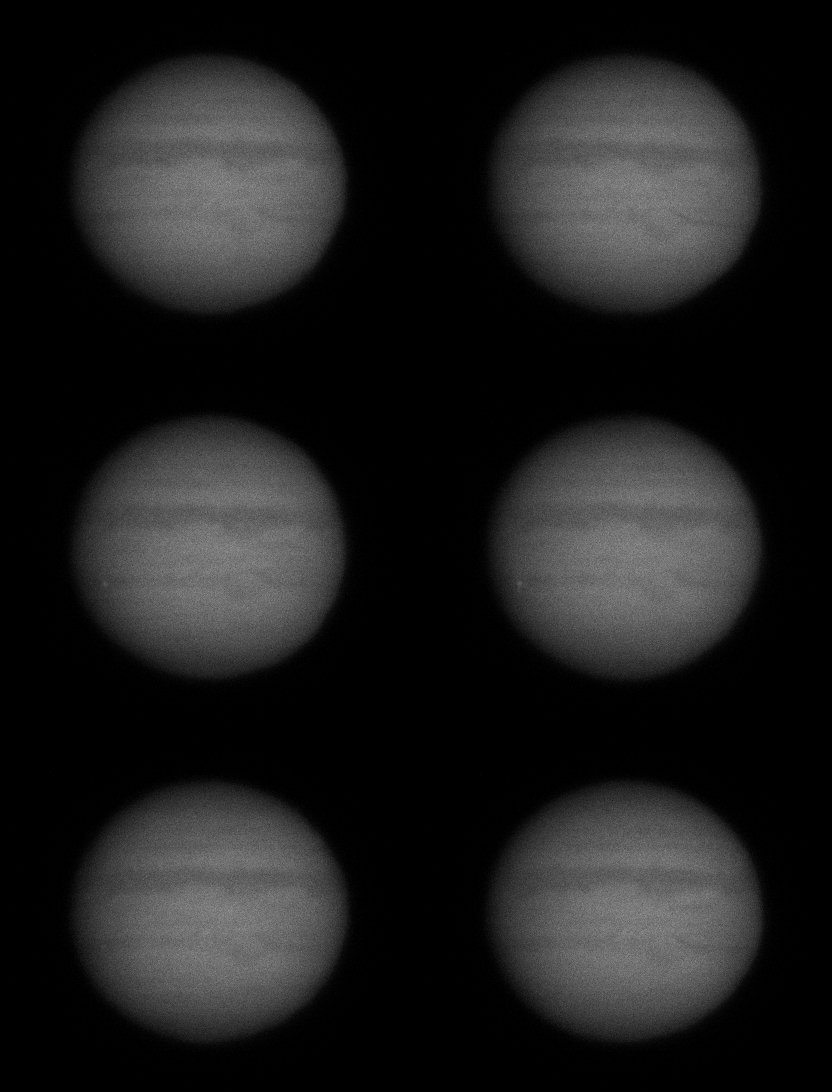
Analysis of a bright flash in Jupiter's atmosphere observed by an amateur astronomer in August 2019 has revealed that the likely cause was a small asteroid with a density typical of stony-iron meteorites. The impact is estimated to have released energy equivalent to an explosion of 240 kilotons of TNT - around half the energy released in the 2013 Chelyabinsk event at Earth. The results have been presented at the EPSC-DPS Joint Meeting 2019 in Geneva. Ethan Chappel from Cibolo Texas captured a short flash of light at 04:07 UTC on 7th August in video observations of Jupiter using a small telescope in his backyard. The flash lasted for about 1.5 seconds and, at its peak, appeared as bright as Jupiter's moon Io. Chappel continued his observations for the next half hour without knowing he had been the only witness of a planetary collision. Once inside, Chappel analysed the video data using DeTeCt, an open source software specially designed to identify impacts in Jupiter. On finding a clear image of a flash in one of the videos, he quickly got in touch with the developers of the DeTeCt project, Marc Delcroix and Ricardo Hueso, who in turn contacted their large network of amateurs to see if any other detections had been made. Marc Delcroix, a French amateur astronomer, said: "I was thrilled when Ethan contacted me. This is the first impact flash at Jupiter found using the DeTeCt software. These detections are extremely rare because the impact flashes are faint, short and can be easily missed while observing the planets for hours. However, once a flash is found in a video recording it can be analysed to quantify the energy required to make it visible at a distance of 700 million kilometres." Over the past month, Ramanakumar Sankar and Csaba Palotai of the Florida Institute of Technology (FIT), have made an in-depth analysis of the data. They estimate from the energy released by the flash that the impactor could have been an object around 12-16 metres in diameter and with a mass of about 450 tons that disintegrated in the upper atmosphere at an altitude of about 80 kilometres above Jupiter's clouds. Sankar and Palotai's models of the light-curve for the flash suggest the impactor had a density typical of stony-iron meteors, indicating that it was a small asteroid rather than a comet. Hueso, of UPV/EHU in Spain, has made a very similar estimate for the size and mass of the impactor through comparisons with the previous impact flashes detected. The flash appears to have been the second brightest of the six observed so far at Jupiter and offers the greatest potential for detailed data analysis. "With six impact flashes observed in ten years since the first flash was discovered in 2010, scientists are becoming more confident in their estimates of the impact rate of these objects in Jupiter. Most of these objects hit Jupiter without being spotted by observers on Earth. However, we now estimate 20-60 similar objects impact with Jupiter each year. Because of Jupiter's large size and gravitational field this impact rate is ten thousand times larger than the impact rate of similar objects on Earth," said Hueso. Hueso and Delcroix hope that more amateur astronomers will routinely use DeTeCt to analyse video observations of Jupiter and Saturn so that more of these impacts can be found and studied. Delcroix said: "The amateur community has been galvanized by this event and the number of observers and the volume of data being processed is increasing rapidly. DeTeCt is a fantastic showcase for pro-am collaboration." Source: EPSC-DPS Joint Meeting 2019
Research Report: "Jupiter and Saturn Impact Detection Project," M. Delcroix, R. Hueso and J. Juaristi, EPSC-DPS 2019 PDF

ALMA shows what's inside Jupiter's storms Charlottesville VA (SPX) Aug 23, 2019 Swirling clouds, big colorful belts, giant storms -the beautiful and turbulent atmosphere of Jupiter has been showcased many times. But what is going on below the clouds? What is causing the many storms and eruptions that we see on the 'surface' of the planet? To see this, visible light is not enough. We need to study Jupiter using radio waves. New radio wave images made with the Atacama Large Millimeter/submillimeter Array (ALMA) provide a unique view of Jupiter's atmosphere down to fifty kilomet ... read more
|
|||||||||||||
|
|
| The content herein, unless otherwise known to be public domain, are Copyright 1995-2024 - Space Media Network. All websites are published in Australia and are solely subject to Australian law and governed by Fair Use principals for news reporting and research purposes. AFP, UPI and IANS news wire stories are copyright Agence France-Presse, United Press International and Indo-Asia News Service. ESA news reports are copyright European Space Agency. All NASA sourced material is public domain. Additional copyrights may apply in whole or part to other bona fide parties. All articles labeled "by Staff Writers" include reports supplied to Space Media Network by industry news wires, PR agencies, corporate press officers and the like. Such articles are individually curated and edited by Space Media Network staff on the basis of the report's information value to our industry and professional readership. Advertising does not imply endorsement, agreement or approval of any opinions, statements or information provided by Space Media Network on any Web page published or hosted by Space Media Network. General Data Protection Regulation (GDPR) Statement Our advertisers use various cookies and the like to deliver the best ad banner available at one time. All network advertising suppliers have GDPR policies (Legitimate Interest) that conform with EU regulations for data collection. By using our websites you consent to cookie based advertising. If you do not agree with this then you must stop using the websites from May 25, 2018. Privacy Statement. Additional information can be found here at About Us. |


 del.icio.us
 Digg
Digg Reddit
 Google