
 |
 |
 |
 |
 |
 |
 |
 |
 |
 |

| . |  |
. |

Paris, France (ESA) Aug 27, 2010 High school students from different ESA Member States were able to watch their own 'satellites' soar into the sky aboard suborbital rockets during the first European CanSat competition, held at the Andoya Rocket Range in Norway. The CanSat competition, organised by ESA's Education Office and the Norwegian Centre for Space-related Education (NAROM), was open to teams of at least four students, assisted by a teacher or tutor. The selected teams had to build their own small CanSat 'satellite' in six months, with each team developing an experiment that would fit inside a 350 ml soft drink can. These investigations ranged from calculating variations in Earth's magnetic field and tracking the Sun, to measuring solar radiation and levels of carbon dioxide. The competition's opening ceremony took place on 16 August, with speeches from representatives of ESA, NAROM and Andoya Rocket Range. Each team then presented its project to a jury of technical experts from ESA, NAROM, the International Astronautical Federation and the Norwegian Space Centre. The most exciting day was 17 August, when the students were able to watch five Intruder rockets launch their CanSats from Skarsteindalen, a former military facility close to Andoya Rocket Range. The mini-payloads soared to an altitude of 1 km before parachuting back to Earth. Although there were some last-minute technical hiccups, all CanSats were deployed successfully and all teams were able to perform at least part of their scientific missions. The culmination of the competition was the prize ceremony on 18 August, when the expert jury announced the results of its evaluation of the projects and selected the three winning teams. The bronze award went to the Brussels Vikings team from Sint-Pieterscollege Jette in Belgium, while the Irish team Triailliu from Laurel Hill School, Limerick, won the silver award. The gold award winners were 'Team Eclipse' from St Paul's School in London, United Kingdom. All three teams received a trophy and prizes which included a handheld SkyScout planetarium for their schools. "Over the course of half a year, we encountered setbacks and discovered this project was much more difficult than we had originally anticipated," said Bryant Tan from the winning British team. "Despite this, we won a European competition, made some amazing friends, took some great photos of the staggeringly beautiful scenery and learnt some lasting lessons. It's been an amazing experience!" CanSats and Europe A CanSat is a simulation of a real satellite, integrated within the volume and shape of a regular soft drink can. CanSats offer unique opportunities for students to experience their first real space-related project. The participating countries in the first competition were Belgium, Czech Republic, Denmark, Greece, Italy, Ireland, Norway, Spain, Sweden and United Kingdom. The European CanSat competition is one of many ESA hands-on initiatives to inspire young people to follow a career in science or engineering. In this way, it is hoped to ensure the availability of a highly qualified work force in the space industry of the future. One of the primary objectives of the competition is to promote the CanSat concept in ESA Member States. Similar competitions already exist in some ESA Member States and ESA is seeking to support additional CanSat activities from 2011.
Share This Article With Planet Earth
Related Links European CanSat competition Space Technology News - Applications and Research

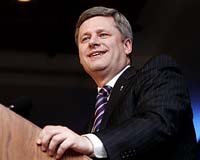 Canadian PM Announces Support For Next Gen Of Satellites
Ottawa, Canada (SPX) Aug 27, 2010 Prime Minister Stephen Harper has announced support for the next phase of the RADARSAT Constellation Mission (RCM), a system of three advanced remote sensing satellites. "By supporting the world-class RADARSAT Constellation Mission, our Government will ensure Canada maintains its role as a world leader in aerospace technology," Prime Minister Harper said. "This cutting-edge project w ... read more |
|
|
| The content herein, unless otherwise known to be public domain, are Copyright 1995-2010 - SpaceDaily. AFP and UPI Wire Stories are copyright Agence France-Presse and United Press International. ESA Portal Reports are copyright European Space Agency. All NASA sourced material is public domain. Additional copyrights may apply in whole or part to other bona fide parties. Advertising does not imply endorsement,agreement or approval of any opinions, statements or information provided by SpaceDaily on any Web page published or hosted by SpaceDaily. Privacy Statement |


 del.icio.us
 Digg
Digg Reddit
 YahooMyWeb
 Google
 Facebook


