|
 |
 |
 |
 |
 |
 |
 |
 |
 |

| . |  |
. |
Students Create First-Ever Bacterial Photographs
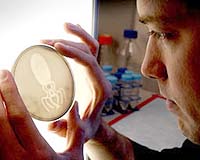
Moffett Field CA (SPX) Nov 28, 2005 Using Petri dishes full of genetically engineered E. coli instead of photo paper, students at The University of Texas at Austin and UCSF have successfully created the first-ever bacterial photographs. Their work is published in last week's issue of Nature (Nov. 24, 2005), which is devoted entirely to the emerging field of synthetic biology. The students produced the innovative bacterial images and a bacterial camera as part of MIT's intercollegiate Genetically Engineered Machine (iGEM) competition, which encourages students to build simple biological machines. "The goal of the contest was to build bacteria that could do very simple computing," says Dr. Edward Marcotte, one of the students' faculty advisers and associate professor of biochemistry at The University of Texas at Austin. "This is a great example of the emergent field of synthetic biology--using principles of engineering in biology." "We're making bacteria that are all independently functioning computers and we can get them to do large-scale, complex computations like make images or create circuits," says Jeff Tabor, a doctoral student at the Institute for Cell and Molecular Biology in Austin. The students produced ghostlike, living photos of many things, including themselves, their advisers and The University of Texas Tower. The bacterial photos were created by projecting light on "biological film"--billions of genetically engineered E. coli growing in dishes of agar, a standard jello-like growth medium for bacteria. Like pixels on a computer screen switching between white and black, each bacterium either produced black pigment or didn't, based on whether it was growing in a light or dark place in the dish. The resulting images are a collection of all the bacteria responding to the pattern of light. E. coli are found naturally in the dark confines of the human gut and wouldn't normally sense light, so the students had to engineer the unicellular machines to work as a photo-capturing surface. UCSF biophysics graduate student Anselm Levskaya and his adviser, Dr. Chris Voigt, first engineered the bacteria to sense light by adding a light receptor protein from a photosynthetic blue-green algae to the E. coli cell surface. They hooked the light receptor up to a sensor in E. coli that normally senses salt concentration. Instead of sensing salt, the bacteria could sense light. The light receptor was then connected to a system in the bacteria that makes pigments. When light strikes the new receptor, it turns off a gene that ultimately controls the production of a colored compound in the bacteria. The Texas students, including Tabor and Aaron Chevalier, realized that after optimizing the pigments and agar growth media, these bacteria could be used to convert light images shined onto the bacteria into biochemical prints. To create the photographs, the Texas students used a unique light projector largely designed and built by Chevalier, a physics undergraduate. The device projects the pattern of light--like an image of one of the Texas students' co-advisers, Dr. Andy "Escherichia" Ellington--onto the dish of bacteria growing at body temperature in an incubator. After about 12-15 hours of exposure (the time it takes for a bacterial population to grow and fill the Petri dish), the light projector is removed. What's left is a living photograph. Bacteria in the lighted regions of the Petri dish don't produce the pigment and appear light. Those in the dark regions produce pigment and appear dark. The biological technologies these students are building could be applied in a variety of ways beyond making photos, says Marcotte. For example, he says the techniques could one day be used to build different tissues based on patterns of light or make bacteria that can produce structures useful in medical treatments. The students are already busy on their next innovation--bacteria that can find and create a line around the edges of an image, a process that requires the bacteria to communicate with each other. They're also working on experiments using a laser to turn on and off single cells, which would give them great control. "If we can hit the cell with a laser, we can manipulate their biology without needles or syringes," says Tabor. "We just turn it on or off with light." Related Links University of Texas at Austin UCSF SpaceDaily Search SpaceDaily Subscribe To SpaceDaily Express  Shakeup Of Reptile Family Tree Reveals Surprising Genetic Relationships
 Moffett Field CA (SPX) Nov 28, 2005
The most comprehensive analysis ever performed of the genetic relationships among all the major groups of snakes, lizards, and other scaly reptiles has resulted in a radical reorganization of the family tree of these animals, requiring new names for many of the tree's new branches. |
|
|

| The content herein, unless otherwise known to be public domain, are Copyright 1995-2006 - SpaceDaily.AFP and UPI Wire Stories are copyright Agence France-Presse and United Press International. ESA PortalReports are copyright European Space Agency. All NASA sourced material is public domain. Additionalcopyrights may apply in whole or part to other bona fide parties. Advertising does not imply endorsement,agreement or approval of any opinions, statements or information provided by SpaceDaily on any Web page published or hosted by SpaceDaily. Privacy Statement |