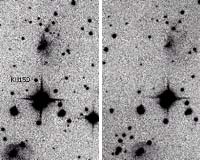
Images of KH 15D out of eclipse (left) and in eclipse (right). Image by Van Vleck Observatory
Images of KH 15D out of eclipse (left) and in eclipse (right). Image by Van Vleck Observatory |
The international team that maked the observation was led by William Herbst and Catrina Hamilton of Wesleyan University in Middletown, Conn. The results are being presented to the Scientific Frontiers on Research in Exo-Solar Planets meeting sponsored by NASA and the Carnegie Institution of Washington in Washington, D.C.
This discovery is enabling first-time study of the detailed structure of a disk and to see the evolution of features on time scales of months and years. It is believed that disks such as this formed Earth and our solar system. Scientists hope that this discovery will shed new light on our origins.
The star, named KH 15D, is in the constellation of Monoceros and located about 2,400 light years from the Earth. It is part of a well known cluster of young stars called NGC 2264 and inhabits a nebulous region of space close to the famous "Cone Nebula" (recently imaged in spectacular fashion with the new Advanced Camera System on the Hubble Space Telescope.) Such regions are known to be the birthplaces of stars and KH 15D has all the markings of youth. It is estimated to be about 3 million years old, qualifying it as a cosmic toddler.
Attention was drawn to the star in 1997 by its discoverers, Kristin Kearns, then a graduate student at Wesleyan and Herbst. It was star number 15 in an image which they designated the "D" field, hence the name. "If we knew it was going to become famous, we would have given it a better name," Herbst now laments.
Observations, mostly by undergraduate students, at Wesleyan's Van Vleck Observatory during the late 1990's led Kearns and Herbst to realize that this was a potentially unique and important object.
"Basically, the star winked at us," reports Herbst. On most nights it was at its standard brightness but sometimes it would be nearly gone -- shining by only a tiny fraction of its normal luminosity.
After several years of study, the pair recognized a pattern to the star's behavior -- it fades out every 48.3 days and stays faint for about 18 days. The strict repetitiveness and other characteristics led to the realization that something was orbiting the star and blocking its light on a regular timetable. This is not uncommon in astronomy -- there are many known examples of eclipsing binary stars.
What is uncommon -- unique, actually -- in the case of KH 15D is the length of the eclipse as well as its depth. The star was essentially totally blocked for more than 1/3 of the period of the orbiting matter.
No single object such as a star, planet or moon could do such a thing, since it would require an object much too large to fit in the space available. Only a collection of smaller objects -- dust grains, rocks or perhaps asteroids -- orbiting together in a strung out, clumpy arc, could possibly explain such a lengthy eclipse.
To examine this unprecedented phenomenon in greater detail, Herbst and Wesleyan physics graduate student Catrina Hamilton, who is also a senior lecturer at Connecticut College in New London, Conn., organized an international observing campaign during the fall, winter and spring of 2001/2002.
The goal was to keep an eye on this amazing star for as much of the time as was practical. Astronomers from Uzbekistan, Germany, Israel, Spain, and at several universities in the United States took part in the observations.
The extensive data set obtained in the past year has confirmed the basic pattern seen previously and provided tantalizing new facts for astronomers to study.
Related Links
 The Origins Of Australian Science
 Sydney - Jun 11, 2002
| The content herein, unless otherwise known to be public domain, are Copyright 1995-2006 - SpaceDaily.AFP and UPI Wire Stories are copyright Agence France-Presse and United Press International. ESA PortalReports are copyright European Space Agency. All NASA sourced material is public domain. Additionalcopyrights may apply in whole or part to other bona fide parties. Advertising does not imply endorsement,agreement or approval of any opinions, statements or information provided by SpaceDaily on any Web page published or hosted by SpaceDaily. Privacy Statement |