|
 |
 |
 |
 |
 |
 |
 |
 |
 |

| . |  |
. |
Superbots In Action
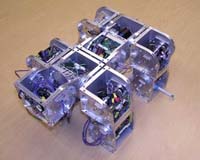
Los Angeles CA (SPX) Mar 05, 2007 Vivid on-line videos demonstrate Superbot progress USC's lego-like autonomous robotic units show off ability to reconfigure into different systems for different tasks in online .wmv files. Wei-Min Shen of the University of Southern California's Information Sciences Institute recently reported to NASA significant progress in developing "SuperBot," identical modular units that plug into each other to create robots that can stand, crawl, wiggle and even roll. He has illustrated his comments with striking video of the system in action, video now posted on line. Shen's presentation took place at the Space Technology and Applications International Forum 2007 (STAIF) held in Albuquerque, New Mexico. For the report, he first offered a description of the SuperBot work: "Superbot consists of Lego-like but autonomous robotic modules that can reconfigure into different systems for different tasks. Examples of configurable systems include rolling tracks or wheels (for efficient travel), spiders or centipedes (for climbing), snakes (for burrowing in ground), long arms (for inspection and repair in space), and devices that can fly in micro-gravity environment. This range of abilities that can be accomplished by modular robots could play a major role in future exploration missions and in the search for life in the solar system. "Each module is a complete robotic system and has a power supply, micro-controllers, sensors, communication, three degrees of freedom, and six connecting faces (front, back, left, right, up and down) to dynamically connect to other modules. "This design allows flexible bending, docking, and continuous rotation. A single module can move forward, back, left, right, flip-over, and rotate as a wheel. Modules can communication with each other for totally distributed control and can support arbitrary module reshuffling during their operation. "They have both internal and external sensors for monitoring self status and environmental parameters. They can form arbitrary configurations (graphs) and can control these configurations for different functionality such as locomotion, manipulation, and self-repair." Shen illustrated his words with SuperBot action video showing these processes. He and his colleagues and students made the films in just one week, immediately after completing the mechanics and electronics hardware for the latest batch of SuperBot modules at the beginning of February. "The fact that SuperBot can achieve so much in so short a time demonstrates the unique value of modular, multifunctional and self-reconfigurable robots," Shen said. Email This Article
Related Links 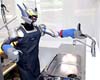 Tokyo (AFP) March 2, 2007
Japan's advanced humanoids can now serve tea and wash the cup afterwards, but they still need to learn from their mistakes if they are to become real household helpers. A Tokyo University team this week showed their latest robots which can perform more complicated daily tasks, but the machines still have a learning curve. |
|
|

| The content herein, unless otherwise known to be public domain, are Copyright 1995-2006 - SpaceDaily.AFP and UPI Wire Stories are copyright Agence France-Presse and United Press International. ESA PortalReports are copyright European Space Agency. All NASA sourced material is public domain. Additionalcopyrights may apply in whole or part to other bona fide parties. Advertising does not imply endorsement,agreement or approval of any opinions, statements or information provided by SpaceDaily on any Web page published or hosted by SpaceDaily. Privacy Statement |