
 |
 |
 |
 |
 |
 |
 |
 |
 |
 |

| . |  |
. |
Supernova Birth Seen For First Time
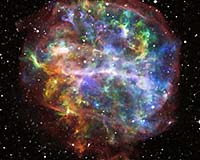
Pasadena CA (SPX) May 23, 2008 Astronomers have seen the aftermath of spectacular stellar explosions known as supernovae before, but until now no one has witnessed a star dying in real time. While looking at another object in the spiral galaxy NGC 2770, using NASA's orbiting Swift telescope, Carnegie-Princeton fellows Alicia Soderberg and Edo Berger detected an extremely luminous blast of X-rays released by a supernova explosion. They alerted 8 other orbiting and on-ground telescopes to turn their eyes on this first-of-its-kind event. The research appears in the May 22, 2008, issue of Nature magazine. "We were in the right place, at the right time, with the right telescope on January 9th and witnessed history," remarked Soderberg. "We were looking at another, older supernova in the galaxy, when the one now known as SN 2008D went off. We would have missed it if it weren't for Swift's real-time capabilities, wide field of view, and numerous instruments." Supernovae are the explosions of massive stars-stars more than 8 times the mass of the Sun-whose cores run out of nuclear fuel and collapse in on themselves to form a neutron star or a black hole. In the process they launch a powerful shock wave that blows up the star. Until now, observations of these objects have been of the aftermath, typically several days after the initial explosion, not the first instance of death. Astrophysicists have predicted nearly 4 decades ago that the first sign of a supernova would be an X-ray blast, but none had been witnessed before Soderberg's and Berger's Swift observations. "Using the most powerful radio, optical, and X-ray telescopes on the ground and in space we were able to observe the evolution of the explosion right from the start," said Berger. "This eventually confirmed that the big X-ray blast marked the birth of a supernova." This massive across-the-spectrum collaboration looked at SN 2008D for more than 30 days to rule out that the event was anything other than a supernova. They also determined that the object is a typical Type Ibc supernova and measured the size of the star prior to the explosion. "This first instance of catching the X-ray signature of stellar death is going to help us fill in a lot of gaps about the properties of massive stars, the birth of neutron stars and black holes, and the impact of supernovae on their environments," said Neil Gehrels, principal investigator of the Swift satellite. "We also now know what X-ray pattern to look for. Hopefully we will be able to find many more supernovae at this critical moment." The potential of finding a large number of supernovae at the time of explosion will also open up avenues of research that previously seemed nearly impossible. In particular, the determination of the exact explosion time will allow searches for neutrino and gravitational wave bursts that are predicted to accompany the collapse of the stellar core and the birth of the neutron star. "The next generation of X-ray satellites will find hundreds of supernovae every year exactly when they explode," said Soderberg. "I am thrilled that our discovery is leading this new wave of astronomy." Community Email This Article Comment On This Article Share This Article With Planet Earth
Related Links Swift Stellar Chemistry, The Universe And All Within It
 Swift Satellite Observes A Supernova Explosion In Real-Time
 London, UK (SPX) May 22, 2008
UK astronomers are part of an international team that has used the Swift satellite to observe the first moments of a supernova explosion as it happens. The results are presented in a paper in the journal Nature today (22 May 2008) led by Dr. Alicia Soderberg of Princeton University. |
|
|

| The content herein, unless otherwise known to be public domain, are Copyright 1995-2007 - SpaceDaily.AFP and UPI Wire Stories are copyright Agence France-Presse and United Press International. ESA Portal Reports are copyright European Space Agency. All NASA sourced material is public domain. Additional copyrights may apply in whole or part to other bona fide parties. Advertising does not imply endorsement,agreement or approval of any opinions, statements or information provided by SpaceDaily on any Web page published or hosted by SpaceDaily. Privacy Statement |
 del.icio.us
 Digg
Digg Reddit
 YahooMyWeb
 Google
 Facebook