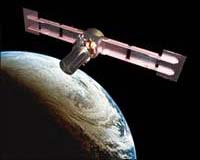
After completing its historic, one year experimental mission, the U.S. Air Force's TacSat-2 microsatellite ceased operations on Dec. 21, 2007. Launched on Dec. 16, 2006, from NASA's Wallops Island Flight Facility, Wallops Island, Va., the responsive space Advanced Concept Technology Demonstration, administered by the Air Force Research Laboratory's Space Vehicles Directorate here, served as the forerunner for speedy satellite production, launch, and operation.
TacSat-2 mission milestones included demonstrating the rapid development and deployment of a spacecraft suitable for tactical use; accomplishing web-based, time critical payload tasking and information distribution from in-theater systems employed for aircraft and unmanned aerial vehicle communications; collecting tactically relevant imagery and signals intelligence data; performing real-time signal geo-location and identification of emitters using satellite and aircraft-based collection platforms; and supporting 10 science and technology payloads.
"The longevity of TacSat-2's operations helped enable the project to achieve significant milestones that will advance the larger operationally responsive space concept," said Neal Peck, TacSat-2 program manager.
Another historical first for TacSat-2 involved ground operators successfully tasking and receiving processed data within 90 minutes with traceability to future turnaround times as short as 10 minutes.
"The project team demonstrated the feasibility of making a space asset suitable for direct tactical use and proved that front-line combatants can directly command payloads via existing military networks," said Charles Finley, TacSat-2 operations manager.
In addition, TacSat-2's color imager, constructed with commercial components at the Space Vehicles Directorate, allowed researchers to gain important insights into low-cost designs and enhanced understanding of the resolution requirements suitable for tactical applications.
The microsatellite's Automated Identification System hardware, designed to capture position information from ocean-going ships, demonstrated that AIS signals could be successfully collected from space over extensive areas of open water. The project also provided insights into how to design AIS hardware and software to handle dense signal environments associated with crowded sea lanes, a topic of keen interest to the U.S. Coast Guard participants in the experiment.
TacSat-2's experimental mission also completed science and technology objectives associated with the numerous non-tactical payloads. These included a high efficiency Hall-Effect Thruster, two different atmospheric sensors, a high precision Star Tracker, a vibration damping system, and thin-film amorphous silicon solar arrays.
TacSat-2 involved an active partnership between the Space Vehicles Directorate, the Space and Missile Systems Center's Space Development and Test Wing, the Naval Research Laboratory, the Army Space Program Office, Air Force Space Command, U.S. Strategic Command, and the Office of Under Secretary of Defense for Acquisition, Technology and Logistics.
"What the TacSat-2 team accomplished is far beyond what anyone envisioned when a group of researchers met to discuss the concepts of a viable, low-cost, operationally responsive space demonstrator in the summer of 2003," said Mr. Peck. "TacSat-2 proved that the concept can be achieved."