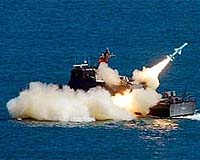
File image Hsiung-feng 2E cruise missile.
File image Hsiung-feng 2E cruise missile. |
Taipei has begun deploying its Hsiung-feng 2E cruise missiles, which have a range of 600 kilometres (360 miles), the Taipei-based China Times said.
"The military had planned to further the range to 1,000 kilometres, so that they could be used to hit Shanghai" in case of war with China, the paper said, citing an unnamed military source.
But as relations improve with Beijing, the island's defence ministry "has decided to drop the idea... to place its priority on the improvement of quality for the existing cruise missiles," the paper said.
The ministry did not comment directly on the report, saying only that it would continue to acquire weapons as a defensive measure, and that they would not be used to attack civilian targets in China should war ever break out.
China and Taiwan have been governed separately since the end of a civil war in 1949, but Beijing still sees the island as part of its territory awaiting reunification, by force if necessary.
China has repeatedly threatened to invade Taiwan should the island declare formal independence.
But tensions across the Taiwan Strait have eased since Taiwanese President Ma Ying-jeou was elected in March on a platform to boost the economy and improve ties with China. He took office in May.
Local newspapers reported at the weekend that the defence ministry plans to scale back its military spending in 2009 to 315.2 billion Taiwan dollars (10 billion US), a decline of 10.4 billion Taiwan dollars from this year.
The draft budget, which still requires parliamentary approval, has drawn criticism from opposition lawmakers who say such a move would signal that Taipei lacks the determination to defend itself.
Community
 del.icio.us del.icio.us |
 Digg Digg |
 Reddit Reddit |
 YahooMyWeb YahooMyWeb |
 Google Google |
 Facebook Facebook |
 Taiwan to mass-produce anti-ship missiles: report
 Taipei (AFP) Aug 29, 2008
| The content herein, unless otherwise known to be public domain, are Copyright 1995-2007 - SpaceDaily.AFP and UPI Wire Stories are copyright Agence France-Presse and United Press International. ESA Portal Reports are copyright European Space Agency. All NASA sourced material is public domain. Additional copyrights may apply in whole or part to other bona fide parties. Advertising does not imply endorsement,agreement or approval of any opinions, statements or information provided by SpaceDaily on any Web page published or hosted by SpaceDaily. Privacy Statement |