|
|
|
|
|
|
|
|
|
|
|


| . |  |
. |
|
|
|
 by Lynn Yarris for Berkeley News Berkeley CA (SPX) Nov 13, 2013
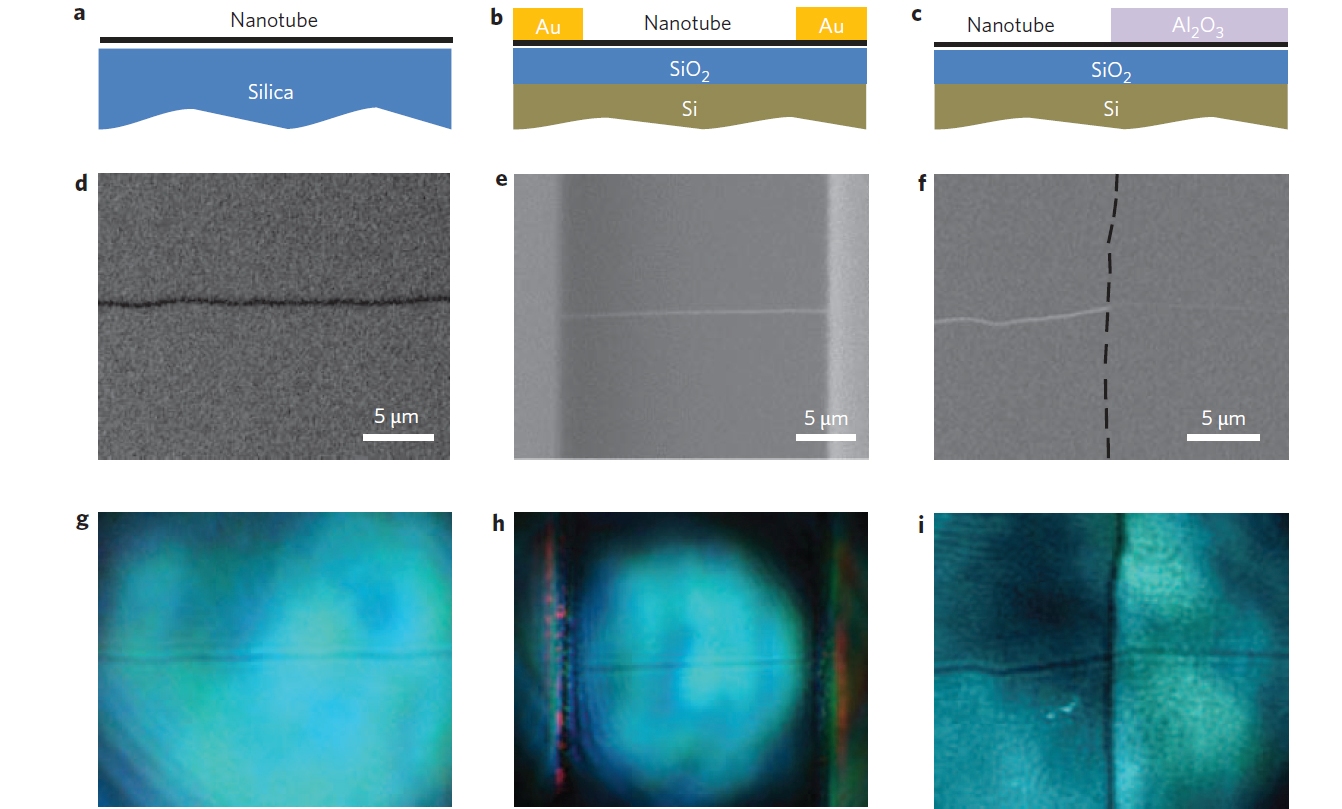
Despite their almost incomprehensibly small size - a diameter about one ten-thousandth the thickness of a human hair - single-walled carbon nanotubes come in a plethora of different "species," each with its own structure and unique combination of electronic and optical properties. Characterizing the structure and properties of an individual carbon nanotube has involved a lot of guesswork - until now. Researchers with the U.S. Department of Energy (DOE)'s Lawrence Berkeley National Laboratory (Berkeley Lab) and the University of California (UC) Berkeley have developed a technique that can be used to identify the structure of an individual carbon nanotube and characterize its electronic and optical properties in a functional device. "Using a novel high-contrast polarization-based optical microscopy set-up, we've demonstrated video-rate imaging and in-situ spectroscopy of individual carbon nanotubes on various substrates and in functional devices," says Feng Wang, a condensed matter physicist with Berkeley Lab's Materials Sciences Division. "For the first time, we can take images and spectra of individual nanotubes in a general environment, including on substrates or in functional devices, which should be a great tool for advancing nanotube technology." Wang, who is also a professor with UC Berkeley's Physics Department, is the corresponding author of a paper describing this research in the journal Nature Nanotechnology. The paper is titled "High-throughput optical imaging and spectroscopy of individual carbon nanotubes in devices." Co-authors are Kaihui Liu, Xiaoping Hong, Qin Zhou, Chenhao Jin, Jinghua Li, Weiwei Zhou, Jie Liu, Enge Wang and Alex Zettl. A single-walled carbon nanotube can be metallic or semiconducting depending on its exact structure. Semiconducting nanotubes can have very different electronic bandgaps, resulting in wildly different electronic or optical properties. "To fully understand field-effect devices or optoelectronic devices made from single-walled carbon nanotubes, it is critical to know what species of carbon nanotube is in the device," Wang says. "In the past, such information could not be obtained and researchers had to guess as to what was going on." The physical structure and electronic properties of each individual species of single-walled carbon nanotubes are governed by chirality, meaning their structure has a distinct left/right orientation or "handedness," which cannot be superimposed on a mirror image. As a result, achieving chirality-controlled growth of carbon nanotubes and understanding the physics behind chirality-dependent devices are two of the biggest challenges in nanotube research. "Polarization-based optical microscopy and spectroscopy techniques are well-suited for meeting these challenges, as polarized light is extremely sensitive to optical anisotropy in a system and has long been exploited to study chirality in molecules and crystals," Wang says. "However, the small signal and unavoidable environment background has made it difficult to use polarized optical microscopy to study single carbon nanotubes." Difficulties arise from an apparent contradiction in polarization-based optical microscopy. For any optical microscope, a large numerical aperture (NA) objective is crucial for high-spatial resolution, but polarized light passing through a large NA objective becomes strongly depolarized. With their new technique, Wang and his colleagues were able to do what has not been done before and simultaneously achieve both high polarization and high spatial resolution. "The key to our success was the realization that light illumination and light collection can be controlled separately," Wang says. "We used a large NA objective for light collection to obtain high spatial resolution, but were able to create an effectively small NA objective for illumination to maintain high polarization purity." In their set-up, Wang and his colleagues collected nanotube-scattered polarized light with a 0.8 NA objective but used a much more narrow incident beam to create illumination light from a supercontinuum laser with a much smaller NA. The result was polarization an order of magnitude higher than what has been achieved with conventional polarized microscopy and spatial resolution at the nanoscale. This enabled them to obtain complete chirality profiles of hundreds of as-grown carbon nanotubes, and to perform in-situ monitoring in active field-effect devices. "We observed that high order nanotube optical resonances are dramatically broadened by electrostatic doping, an unexpected behavior that points to strong inter-band electron-electron scattering processes dominating the ultrafast dynamics of excited states in carbon nanotubes," Wang says. In addition to individual single-walled carbon nanotubes, Wang and his colleagues say their technique can also be used to greatly enhance the optical contrast of other anisotropic nano-sized materials that are "invisible" to conventional optical microscopes, including graphene nanoribbons, semiconductor nanowires and nanorods, and nanobiomaterials such as actin filaments.
Related Links Berkeley Lab COINS Nano Technology News From SpaceMart.com Computer Chip Architecture, Technology and Manufacture
|
|
|
| The content herein, unless otherwise known to be public domain, are Copyright 1995-2014 - Space Media Network. AFP, UPI and IANS news wire stories are copyright Agence France-Presse, United Press International and Indo-Asia News Service. ESA Portal Reports are copyright European Space Agency. All NASA sourced material is public domain. Additional copyrights may apply in whole or part to other bona fide parties. Advertising does not imply endorsement,agreement or approval of any opinions, statements or information provided by Space Media Network on any Web page published or hosted by Space Media Network. Privacy Statement |

 del.icio.us
 Digg
Digg Reddit
 Google