|
 |
 |
 |
 |
 |
 |
 |
 |
 |

| . |  |
. |
Taliban Go Global
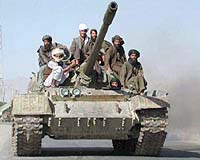
Washington (UPI) Nov 01, 2005 Taliban forces have joined the global ideological jihad, terrorism analysts said last week during a conference on security and terrorism. "They have adopted a new lethal strategy," said Hekmat Karzai, a terrorism analyst, at the Center for Strategic and International Studies in Washington on Wednesday. "This strategy has military and media elements." Karzai, a former first secretary at the Embassy of Afghanistan in Washington, believes the once parochial Taliban is now modeling itself on more nebulous international jihadi organizations, such as al-Qaida. Militarily, the Taliban are adopting tactics and weaponry already tried and tested by insurgents in Iraq, Karzai said. Their improvised bombs are built with increasing sophistication, while operations are directed at 'soft targets,' with the aim of alienating the local population from coalition forces and aid agencies. As in Iraq, beheadings are becoming commonplace, a phenomenon without precedent in Afghanistan. "Afghans say that this is done by Arabs and alien to Afghan culture. But perhaps the Taliban are being influenced more and more by outside forces," said Karzai, explaining that although "the U.S. has destroyed the terrorist Disneyland that once existed in Afghanistan," the Taliban have been quick to adapt to changing circumstances and learn from al-Qaida. "The enemy has changed tremendously. Al-Qaida the group has diminished. But al-Qaida as global jihad is finding tremendous resonance," said Karzai. Al-Qaida has long relied heavily on propaganda to widen its campaign. According to Karzai, the Taliban have learned to market themselves with slick Web site graphics and professionally shot photographs and fast-paced recruitment videos. This globalizing trend has left Afghan intelligence service unable to cope. "Afghan intelligence was trained initially in the 60s by the Soviet KGB (to combat local threats.) They need to undergo a psychological shift and look at the threat emanating from outside," said Karzai. 'Outside' means Chechnya, the Arabian Peninsula and, most frequently, Iraq. "Foreign fighters have returned to Afghanistan. Afghans have traveled to Iraq and trained with the insurgents and Iraqi insurgents have provided training in Afghanistan," said Karzai. But while the Taliban as an organization may be mutating, it remains to be seen if the change is evolutionary, the first indication of a new global threat or simply a last-ditch effort to retain relevance in newly democratic Afghanistan. Peter Bergen, a terrorism specialist at the New America Foundation, says the latter case is by far the more likely. "The Taliban are a spent force. They are irrelevant," Bergen told United Press International, citing the group's inability to obstruct Afghanistan's political development as proof. "We ran the experiment three weeks ago with the election," he said. "The Taliban failed to influence the result." President Hamed Karzai, a pro-Western moderate and Hekmat's cousin, was elected for a second term on Oct. 9. Jason Burke, author of a book on al-Qaida and the Taliban, agrees with Bergen. "The Taliban have followed the same trajectory as almost every other Islamist group," he told UPI. "Just like al-Zawahiri in Egypt or (Osama) bin Laden in Saudi Arabia, they failed to enforce a local agenda." Burke explains that the Taliban, at the outset of a divided movement, united in the late 1990s around hardliners such as Mullah Omar. Omar's outlook was characterized by parochialism and suspicion of outsiders. Only later, through association with bin Laden, did he start to absorb the global jihadist worldview. "Like other groups, they did not deliberately set out on an international strategy. But once they had failed in their parochial aims, the Taliban began to internationalize almost by default." "They came to power in a particular set of circumstances that are unrepeatable," said Burke. "They no longer have a critical mass of popular support." Related Links SpaceDaily Search SpaceDaily Subscribe To SpaceDaily Express  NJIT Physicist Sees Terahertz Imaging As Ultimate Defense Against Terrorism
 Newark NJ (SPX) Nov 01, 2005
John Federici, PhD, professor, department of physics, New Jersey Institute of Technology (NJIT) and other physicists at NJIT recently received a U.S. Patent for a Teraherz imaging system and method. Since 1995, Terahertz imaging has grown in importance as new and sophisticated devices and equipment have empowered scientists to understand its potential. |
|
|

| The content herein, unless otherwise known to be public domain, are Copyright 1995-2006 - SpaceDaily.AFP and UPI Wire Stories are copyright Agence France-Presse and United Press International. ESA PortalReports are copyright European Space Agency. All NASA sourced material is public domain. Additionalcopyrights may apply in whole or part to other bona fide parties. Advertising does not imply endorsement,agreement or approval of any opinions, statements or information provided by SpaceDaily on any Web page published or hosted by SpaceDaily. Privacy Statement |