|
 |
 |
 |
 |
 |
 |
 |
 |
 |

| . |  |
. |
Team Finds Magnetic Islands Are Source of Mysterious High Speed Electrons
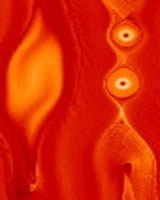
College Park MD (SPX) Oct 06, 2006 A team of scientists led by University of Maryland physics professor James Drake appear to have solved a key remaining mystery about how the interaction of magnetic fields produce the explosive releases of energy seen in solar flares, storms in the Earth's magnetosphere and many other powerful cosmic events. In recent years, researchers have answered many questions about this process, but one thing they have been unable to explain is data from solar observing satellites indicating that up to half of the energy released during solar flares is in the form of energetic electrons. Large numbers of these low-mass particles travel at speeds far higher than can be explained by the widely accepted "slingshot" model for how reconnecting magnetic field lines accelerate charged particles. Now, a team of scientists led by University of Maryland physics professor James Drake appears to have found the answer. In the October 5 edition of the journal Nature, Drake and his colleagues release findings showing that electrons gain speed (kinetic energy) by repeatedly reflecting, or bouncing, off of the ends of contracting 'magnetic islands' that form as the magnetic field lines reconnect. The mechanism is analogous to the increase of energy a pinball gains when it bounces between multiple round bumpers. Except in this case the bumpers (magnetic islands) aren't stationary, they actually converge on the pinball (electron) causing it to gain speed with each bounce. "Ours is the first mechanism that explains why electrons gain so much energy during magnetic reconnection," said Drake, a professor in the Department of Physics and the University of Maryland's Institute for Physical Science and Technology. "And from a practical standpoint, these new findings can help scientists to better predict which solar storms pose the greatest threat to communications and other satellites." Drake explained that the strongest confirming evidence for the new theory was the surprising agreement between their model and data from NASA's WIND satellite. "We were as surprised as the WIND scientists when the distribution of energetic electrons seen by their spacecraft popped right out of our model. Such a match isn't something you see very often," he said. Physicists have long been convinced that the primary mechanism for release of magnetic energy is a process called magnetic reconnection that occurs when oppositely-directed magnetic field lines come in contact. During this process, parallel magnetic field lines break and reconnect, forming back-to-back slingshots that release their energy by exploding outwards in opposite directions. Since charged particles are trapped on magnetic field lines, most of the energy in the magnetic field is converted to the kinetic energy of the ionized particles (plasma) pulled along by the expanding field lines. However, like a rock propelled by the snapping rubber bands of a sling shot, a charged particle can gain only as much speed, or kinetic energy, as that of the moving magnetic field lines that propel it. Until now, scientists have had no convincing mechanism to explain how electrons in Earth's magnetosphere reach energies hundreds of thousands of times higher than the electron energies associated with large-scale reconnection-driven flows.
Storms from the Sun The Earth's magnetic field forms the magnetosphere, which shields the planet, protecting it from solar storms. Solar storms are "winds" of charged particles and radiation flowing from the Sun, often as the result of violent solar eruptions of hot gas known as coronal mass ejections. Even with the protection of Earth's magnetic field, the strongest solar storms can disrupt electric power grids and disturb or damage satellite-based communications and navigation systems. Space weather generally varies with the 11-year sunspot cycle: the more sunspots, the more storms and the more voluminous the "solar wind," as scientists call the stream of charged particles that incessantly blows off the face of the sun. In March of this year scientists with the National Center for Atmospheric Research in Boulder, Colorado, predicted that the next 11-year solar storm cycle should be significantly stronger than the current one, which could mean big problems for cellular phones, GPS systems and other satellite-enabled technology. According to the center, stronger solar storms could start as early as this year or as late as 2008 and should peak around 2012. "Electron acceleration from contracting magnetic islands during reconnection," Nature, October 5, 2006, J. F. Drake, University of Maryland; M. Swisdak, Naval Research Laboratory; H. Che, University of Maryland; and M. A. Shay, University of Delaware Related Links University of Maryland Stellar Chemistry, The Universe And All Within It  Scientists Teleport Two Photons
 Heidelberg (UPI) Sep 20, 2006
Scientists in Germany say they have successfully teleported the combined quantum state of two photons. That achievement is said to be the first for a composite system, and the researchers say their approach could lead to new ways to harness quantum effects for communication and computational purposes. |
|
|

| The content herein, unless otherwise known to be public domain, are Copyright 1995-2006 - SpaceDaily.AFP and UPI Wire Stories are copyright Agence France-Presse and United Press International. ESA PortalReports are copyright European Space Agency. All NASA sourced material is public domain. Additionalcopyrights may apply in whole or part to other bona fide parties. Advertising does not imply endorsement,agreement or approval of any opinions, statements or information provided by SpaceDaily on any Web page published or hosted by SpaceDaily. Privacy Statement |