|
 |
 |
 |
 |
 |
 |
 |
 |
 |

| . |  |
. |
Temple Researcher Attempting To Create Cyclic Ozone
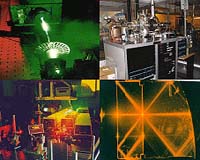
Philadelphia PA (SPX) Feb 02, 2005 Robert Levis, Ph.D., Director of the Center for Advanced Photonics Research, demonstrates the ultrafast laser beams used to detect the cyclic ozone reaction product. Assisting Levis are Alexei Filin, Ph.D.; Ryan Compton; and Matthew Coughlan. With nearly twice the energy of normal, bent-shaped ozone (O3), cyclic ozone could hold the key component for a future manned-mission to Mars. No one has ever seen-let alone made-cyclic ozone. But that could all change at Temple University's Center for Advanced Photonics Research, which has been awarded a one-year, $1.25 million grant to develop cyclic ozone by the Defense Advanced Research Projects Administration (DARPA). The research is being carried out under the guidance of Center Director Robert J. Levis, Ph.D., a pioneer in strong field, laser-based chemistry and adaptive photonics. Strong field chemistry uses ultrafast lasers to produce intense laser pulses that create tremendous electric fields around a molecule. This forms-for a brief instant in time-a new molecule that chemically can react in new and unexpected ways. Levis and his group began pioneering this revolutionary technology about a decade ago. "The formation of cyclic ozone is a high-risk project," concedes Levis. "No one has ever taken ozone and made the free cyclic form, where every oxygen atom is bound to every other oxygen atom, making it look like an equilateral triangle. "Nobody knows exactly what the molecule looks like spectroscopically or how to make it," he adds. "And that's exactly the type of high-risk, high-payoff problem that our laser-based technologies can figure out." Levis points out that the successful production of cyclic ozone could play an important role in putting a human on Mars because rockets could be able to carry one-third more payload. "The bent form of ozone carries about one-and-a-half volts of energy, while cycle ozone carries about three volts," says Levis. "So there's no more mass, but you can get much more energy when the cyclic ozone combines with hydrogen and is burned. "This is way-over-the-horizon research," he adds. "But if you can produce cyclic ozone, that might be a key component to interplanetary space exploration." Because cyclic ozone has never before been characterized, Levis and the Temple researchers-Dmitri Romanov of physics and Spiridoula Matsika of chemistry-are relying exclusively on an evolutionary search strategy theory to help them synthesize the molecule using ultrafast lasers. Researchers from the chemistry and chemical engineering departments at Princeton University and the mathematics department at Yale University have been subcontracted by Levis to assist in the development of the search theory. The Center for Advanced Photonics Research (www.temple.edu/capr) is focused on developing new science and technologies through intense laser-molecule interactions. The center has three of the most powerful laser systems on the East Coast each with a laser pulse shaping capabilities. Research ranges from probing fundamental physics principles to detecting chemical warfare agents. "One of the aspects that DARPA finds fascinating is that these shaped reagents have what's called a massive 'search space,'" says Levis. "The 'search space' is huge, something like 1040 possibilities, more than the number of stars in the universe. There are an incredible number of paths we can take to find cyclic ozone and we have to search through them somehow." Levis equates the size of the search space to the variability in the human genome, composed of four distinct bases strung in a genome containing roughly three billion bases. "That's four to the three billionth different ways you can arrange those four bases," he says. "And yet, humans have evolved into an extremely complex organism." The question is how did this organization occur, and Levis answers by saying that evolution, or Mother Nature, has an excellent search strategy. "What we've managed to do here at the center is take that evolutionary search strategy and put it into an experimental, chemical situation," he says. "It's an experimentalist's dream. We have a target molecule that's never been made before, and we're going to try to make it with technology that is right on the horizon, and we're going to detect it relying on calculations that are state-of-the-art." Levis says his team, which also includes chemist Herschel Rabitz and chemical engineer Yannis Kevrekidis from Princeton and mathematician Raphy Coiffman from Yale, will be making only a small amount of cyclic ozone, since his laser-rigs would not be capable of mass-producing it. "This laser system will only produce micro-grams, which won't power the Space Shuttle," he says. "But once we've made even a little, other scientists and chemical engineers can study it, learn more about the potential energy surface and chemical reactivity, and possibly find a way to reverse engineer a catalyst to produce it in mass quantities." Related Links Temple University SpaceDaily Search SpaceDaily Subscribe To SpaceDaily Express  Lunar Transportation Systems- A New Private Commercial Space Venture
 Bellevue WA (SPX) Feb 02, 2005
Walter Kistler and Bob Citron formed Lunar Transportation Systems early last year in response to the President's new Vision for Space Exploration. LTS's goal is to raise major financing from the private sector to develop, build, ground test, flight test, and operate a new Earth-Moon transportation system. |
|
|

| The content herein, unless otherwise known to be public domain, are Copyright 1995-2006 - SpaceDaily.AFP and UPI Wire Stories are copyright Agence France-Presse and United Press International. ESA PortalReports are copyright European Space Agency. All NASA sourced material is public domain. Additionalcopyrights may apply in whole or part to other bona fide parties. Advertising does not imply endorsement,agreement or approval of any opinions, statements or information provided by SpaceDaily on any Web page published or hosted by SpaceDaily. Privacy Statement |