|
 |
 |
 |
 |
 |
 |
 |
 |
 |

| . |  |
. |
Tenth Planet Has A Moon
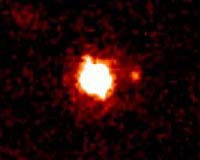
Pasadena CA (SPX) Oct 03, 2005 The newly discovered 10th planet, 2003 UB313, is looking more and more like one of the solar system's major players. It has the heft of a real planet (latest estimates put it at about 20 percent larger than Pluto), a catchy code name (Xena, after the TV warrior princess), and a Guinness Book-ish record of its own (at about 97 astronomical units-or 9 billion miles from the sun-it is the solar system's farthest detected object). And, astronomers from the California Institute of Technology and their colleagues have now discovered, it has a moon. The moon, 100 times fainter than Xena and orbiting the planet once every couple of weeks, was spotted on September 10, 2005, with the 10-meter Keck II telescope at the W.M. Keck Observatory in Hawaii by Michael E. Brown, professor of planetary astronomy, and his colleagues at Caltech, the Keck Observatory, Yale University, and the Gemini Observatory in Hawaii. A paper about the discovery was submitted on October 3 to Astrophysical Journal Letters. "Since the day we discovered Xena, the big question has been whether or not it has a moon," says Brown. "Having a moon is just inherently cool-and it is something that most self-respecting planets have, so it is good to see that this one does too." Brown estimates that the moon, nicknamed "Gabrielle"-after the fictional Xena's fictional sidekick-is at least one-tenth of the size of Xena, which is thought to be about 2700 km in diameter (Pluto is 2274 km), and may be around 250 km across. To know Gabrielle's size more precisely, the researchers need to know the moon's composition, which has not yet been determined. Most objects in the Kuiper Belt, the massive swath of miniplanets that stretches from beyond Neptune out into the distant fringes of the solar system, are about half rock and half water ice. Since a half-rock, half-ice surface reflects a fairly predictable amount of sunlight, a general estimate of the size of an object with that composition can be made. Very icy objects, however, reflect a lot more light, and so will appear brighter-and thus bigger-than similarly sized rocky objects. Further observations of the moon with the Hubble Space Telescope, planned for November and December, will allow Brown and his colleagues to pin down Gabrielle's exact orbit around Xena. With that data, they will be able to calculate Xena's mass, using a formula first devised some 300 years ago by Isaac Newton. "A combination of the distance of the moon from the planet and the speed it goes around the planet tells you very precisely what the mass of the planet is," explains Brown. "If the planet is very massive, the moon will go around very fast; if it is less massive, the moon will travel more slowly. It is the only way we could ever measure the mass of Xena-because it has a moon." The researchers discovered Gabrielle using Keck II's recently commissioned Laser Guide Star Adaptive Optics system. Adaptive optics is a technique that removes the blurring of atmospheric turbulence, creating images as sharp as would be obtained from space-based telescopes. The new laser guide star system allows researchers to create an artificial "star" by bouncing a laser beam off a layer of the atmosphere about 75 miles above the ground. Bright stars located near the object of interest are used as the reference point for the adaptive optics corrections. Since no bright stars are naturally found near Xena, adaptive optics imaging would have been impossible without the laser system. "With Laser Guide Star Adaptive Optics, observers not only get more resolution, but the light from distant objects is concentrated over a much smaller area of the sky, making faint detections possible," says Marcos van Dam, adaptive optics scientist at the W.M. Keck Observatory, and second author on the new paper. The new system also allowed Brown and his colleagues to observe a small moon in January around 2003 EL61, code-named "Santa," another large new Kuiper Belt object. No moon was spotted around 2005 FY9-or "Easterbunny"-the third of the three big Kuiper Belt objects recently discovered by Brown and his colleagues using the 48-inch Samuel Oschin Telescope at Palomar Observatory. But the presence of moons around three of the Kuiper Belt's four largest objects-Xena, Santa, and Pluto-challenges conventional ideas about how worlds in this region of the solar system acquire satellites. Previously, researchers believed that Kuiper Belt objects obtained moons through a process called gravitational capture, in which two formerly separate objects moved too close to one another and become entrapped in each other's gravitational embrace. This was thought to be true of the Kuiper Belt's small denizens-but not, however, of Pluto. Pluto's massive, closely orbiting moon, Charon, broke off the planet billions of years ago, after it was smashed by another Kuiper Belt object. Xena's and Santa's moons appear best explained by a similar origin. "Pluto once seemed a unique oddball at the fringe of the solar system," Brown says. "But we now see that Xena, Pluto, and the others are part of a diverse family of large objects with similar characteristics, histories, and even moons, which together will teach us much more about the solar system than any single oddball ever would." Related Links 2003 UB313 at Caltech SpaceDaily Search SpaceDaily Subscribe To SpaceDaily Express  New Class of Satellites Discovered As Moon Discovered Orbiting 10th Planet
 Mauna Kea, Hawaii (SPX) Oct 03, 2005
Scientists are over the moon at the W.M. Keck Observatory and the California Institute of Technology over a new discovery of a satellite orbiting the Solar System's 10th planet (2003 UB313). The newly discovered moon orbits the farthest object ever seen in the Solar System. |
|
|

| The content herein, unless otherwise known to be public domain, are Copyright 1995-2006 - SpaceDaily.AFP and UPI Wire Stories are copyright Agence France-Presse and United Press International. ESA PortalReports are copyright European Space Agency. All NASA sourced material is public domain. Additionalcopyrights may apply in whole or part to other bona fide parties. Advertising does not imply endorsement,agreement or approval of any opinions, statements or information provided by SpaceDaily on any Web page published or hosted by SpaceDaily. Privacy Statement |