|
 |
 |
 |
 |
 |
 |
 |
 |
 |

| . |  |
. |
Tenth Planet Only Slightly Bigger Than Pluto
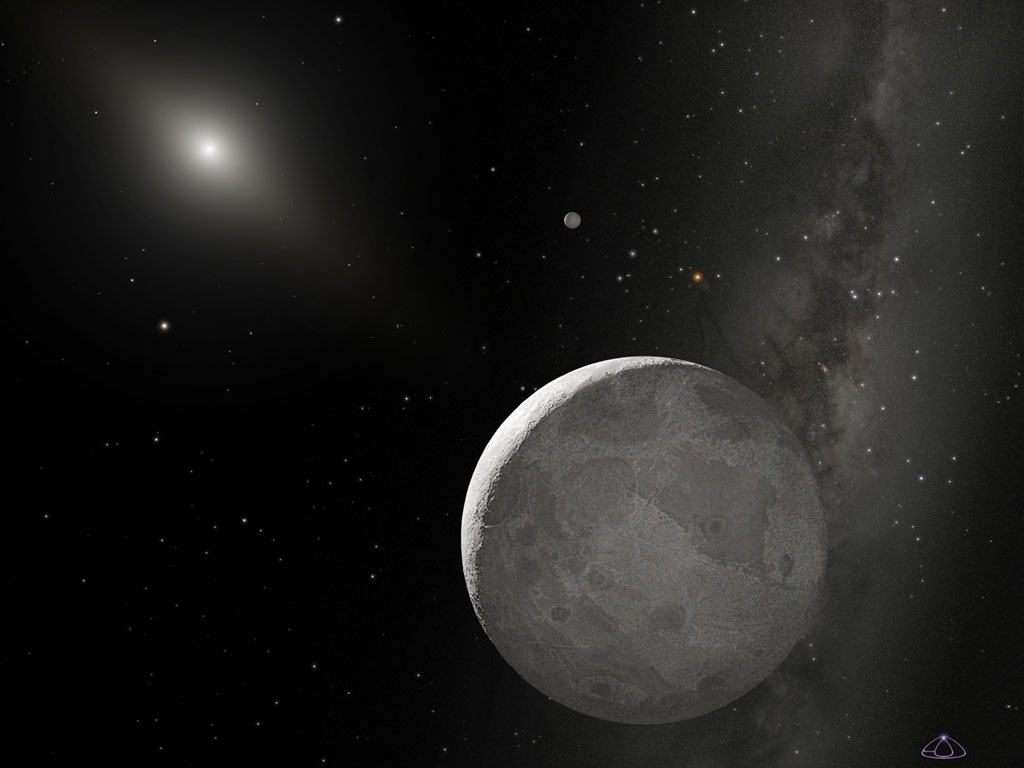
Baltimore MD (SPX) Apr 12, 2006 Scientists using the Hubble Space Telescope have resolved the size of the so-called tenth planet, nicknamed Xena, and found it is only a little larger than Pluto. Previous ground-based observations had suggested Xena - whose official catalog name is Kuiper Belt object 2003 UB313 - was about 30 percent larger than Pluto, Hubble's new observations taken last Dec. 9 and 10, have yielded a diameter of 1,490 miles (with an uncertainty of 60 miles). Pluto's diameter, as measured by Hubble, is 1,422 miles. "Hubble is the only telescope capable of getting a clean visible-light measurement of the actual diameter of Xena," said Mike Brown, planetary scientist at the California Institute of Technology in Pasadena. Brown's research team discovered Xena, and their results have been accepted for publication in the Astrophysical Journal. It required a couple of Hubble images to nail Xena's diameter. It is located about 10 billion miles away, but its diameter is only a little more than half the width of the United States. At that size and distance, the planetary object covers 1.5 pixels in Hubble's frame, but that was enough to make a precise size measurement. Because Xena is smaller than previously thought, but comparatively bright, astronomers think it must be one of the most reflective objects in the solar system. The only object more reflective is Enceladus, the geologically active moon of Saturn whose surface is continuously recoated with highly reflective ice by active geysers. Xena's bright reflectivity could be due to fresh methane frost overlying the surface. It is possible Xena once had an atmosphere when it orbited closer to the Sun, but froze out at its current large distance, and atmospheric material settled on its surface as frost. Another possibility is Xena could be continuously leaking methane gas from its warmer interior. When methane makes it to the cold surface it immediately freezes, covering craters and other features to it uniformly bright to Hubble's telescopic eye. Xena's orbital period is about 560 years, and it currently has moved very close to its aphelion - the point in its orbit farthest from the Sun. Brown said he now plans to use Hubble and other telescopes to study other recently discovered Kuiper Belt Objects that are almost as large as Pluto and Xena. The Kuiper Belt is a vast ring of primordial icy comets and larger bodies encircling Neptune's orbit. He said the discovery that the largest known KBO is a near twin to Pluto could further complicate the debate about whether to categorize the large icy worlds that dwell in the Kuiper Belt as planets or sub-planetary bodies such as asteroids. If Pluto fulfills the minimum size for a planet, then Xena also fits the criterion. Related Links Space Telescope Science Institute Hubble  New Horizons Payload Gets High Marks on Early Tests
 Laurel MD (SPX) Mar 31, 2006
In-flight checks of the New Horizons science payload are going well, as six of the seven instruments on board have completed tests proving they survived launch and demonstrated their basic functionality. |
|
|

| The content herein, unless otherwise known to be public domain, are Copyright 1995-2006 - SpaceDaily.AFP and UPI Wire Stories are copyright Agence France-Presse and United Press International. ESA PortalReports are copyright European Space Agency. All NASA sourced material is public domain. Additionalcopyrights may apply in whole or part to other bona fide parties. Advertising does not imply endorsement,agreement or approval of any opinions, statements or information provided by SpaceDaily on any Web page published or hosted by SpaceDaily. Privacy Statement |