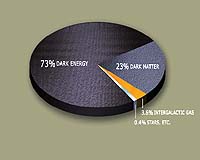
Nearly a decade ago, astronomers discovered the surprising existence of dark energy-a mysterious force that pushes galaxies apart and accelerates the expansion of the universe. Also known as the energy density of the vacuum, dark energy is a property of space itself. Scientists have many questions about the nature of dark energy. One question that soon may be answered: Is the energy density of the vacuum constant over cosmic time?
Theorists Stuart B. Wyithe (University of Melbourne) and Avi Loeb (Harvard-Smithsonian Center for Astrophysics) suggest answering that question by studying the distribution of distant hydrogen clumps, which will yield clues to the history of dark energy.
"The simplest expectation is that the energy density of the vacuum was steady over time-a 'cosmological constant'-but we need to check it out. We might be surprised by the answer," said Loeb.
Dark energy made its first appearance in Einstein's General Theory of Relativity. Einstein believed that the universe was static so he inserted a constant, repulsive force into his equations to counteract the inexorable pull of gravity on all the galaxies. When Edwin Hubble found that the universe is expanding, Einstein threw out the cosmological constant and is rumored to have called it his "biggest blunder."
In 1998, two teams of astronomers discovered that the universe is speeding up, not slowing down under the pull of gravity. They resurrected Einstein's cosmological constant in the form of dark energy. While dark energy clearly exists and its effects are visible to astronomers, no one knows what causes it or whether it is truly constant over time.
"The origin of dark energy is the biggest unsolved problem in astrophysics," said Wyithe.
Investigating Dark Energy
To study the past behavior of dark energy, astronomers must look into the distant universe, to a region whose light took billions of years to travel to Earth. At those great distances, individual galaxies and supernovae - the signposts used to study dark energy in our neighborhood - fade to near-invisibility. A new signpost is needed.
Wyithe and Loeb propose studying the radio emission from neutral hydrogen, whose wavelength is stretched from its starting value of 21 centimeters by the expansion of the universe (a process called redshifting).
After the universe was re-ionized by the first galaxies (sometime in the first billion years), a small fraction of hydrogen remained neutral, surviving in dense pockets. Astronomers had not realized before this work that 21-cm signals from the leftover hydrogen might be detectable.
Wyithe and Loeb showed that, in fact, upcoming observatories will be capable of detecting 21-cm signals from the distant, young universe, even after it gets mostly ionized. Moreover, while the signal strength decreases after re-ionization, the noise also decreases. In principle, the 21-cm signal from neutral hydrogen can be measured from the present epoch all the way up to a redshift of z=15, when the universe was only 200 million years old.
"There is no other viable technique to study dark energy at high redshifts," stated Loeb.
Universal Sound Waves
In the universe's earliest moments, small fluctuations in energy density and pressure caused oscillations, sending out sound waves that expanded across space like ripples in a pond. The size of the outermost "ripple" is about 500 million light-years across today. These universal sound waves influenced the large-scale structure in the distribution of galaxies, and indeed their signature was detected recently in galaxy surveys at low redshifts.
Neutral hydrogen gas should show the same distribution patterns as galaxies due to primordial acoustic oscillations. By studying the large-scale distribution of hydrogen in the early universe, astronomers can learn how dark energy influenced the growth of structure in the crucial first few billion years.
Theoretically, instruments now under construction such as the Murchison (formerly Mileura) Wide-field Array (MWA) and its future extensions could detect 21-cm signals from hydrogen in the first 1 to 4 billion years of the universe's history, corresponding to redshift factors of 1.5 to 6.
"The broad range of redshifts we can reach is important because we can pick up the signal regardless of when the universe was re-ionized," explained Wyithe.