
 |
 |
 |
 |
 |
 |
 |
 |
 |
 |

| . |  |
. |
Texas Astronomer To Aid Search For Earth-like Planets
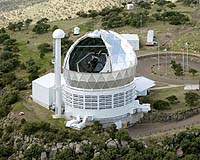
Cape Canaveral FL (SPX) Mar 09, 2009 University of Texas at Austin astronomer Bill Cochran is one of the leading scientists involved in searching 100,000 nearby stars in our Milky Way galaxy for planets like Earth as part of NASA's Kepler mission. The Kepler mission is equipped with a scientific instrument called a photometer, or light meter. It will monitor the brightness of its 100,000 target stars within a single field of view steadily for 3.5 years, looking for periodic dips in their brightness. These dips might indicate an orbiting planet passing in front of the star, an event called a "transit." Once Kepler finds a probable planet, that's where Cochran comes in. "My role is part of the Follow-up Observations Group," he said. "When it detects a transit of a planet around a star, our job is to use other facilities to find out as much as possible about the planet and the star itself. I'll go out to HET," referring to the Hobby-Eberly Telescope at the University's McDonald Observatory in West Texas. Cochran will use HET, one of the world's largest telescopes, to closely monitor the motions of the target star. These observations, combined with the data from Kepler, will determine the planet's mass, a critical factor in determining how similar the planet is to Earth. Of the nearly 350 planets found orbiting stars other than the Sun to date, none have been found with masses as low as Earth's - yet. That's not necessarily due to a lack of Earth-mass planets in our galaxy. It may be simply due to our technological limitations. "We're going to try to push down the mass," Cochran said. "Finding a planet with the mass of Earth is very, very hard." Cochran's follow-up observations might also detect other planets orbiting these stars. If such planets do not transit in front of the star, they will not be seen by Kepler, but should be detectable through Cochran's observing technique with HET. Called "radial velocity," the technique involves monitoring the star's motion toward and away from Earth to detect any wobbles due to the presence of orbiting planets. Fellow University of Texas at Austin astronomer Don Winget is also involved in the Kepler mission. He will use Kepler's measurements of stars' light output over time as way to "see inside" these stars and measure their internal structure - the same way geologists use sound waves to "see inside" Earth. In geology, the technique is called seismology. In astronomy, it's referred to as "asteroseismology." McDonald Observatory's long-running StarDate radio program is an official partner in the Kepler mission's education and public outreach efforts. Two million daily listeners across the United States heard programs on Kepler science this week broadcast by StarDate's nearly 300 affiliated radio stations. The Kepler mission's main goal is to determine the number of Earth-like planets in the Milky Way galaxy, and to understand the characteristics of these planetary systems. With Cochran using McDonald Observatory's giant Hobby-Eberly Telescope to measure these stars' orbits, confirm orbiting planets and discover new ones, and Winget and his team studying the deep interiors of the stars to determine their structure, composition, and ages, The University of Texas at Austin will make a major contribution to Kepler's success. Kepler is a NASA Discovery mission. NASA Ames Research Center, Moffett Field, Calif., is the home organization of the science principal investigator, and is responsible for the ground system development, mission operations and science data analysis. Jet Propulsion Laboratory, Pasadena, Calif., manages the Kepler mission development. Ball Aerospace and Technologies Corp. of Boulder, Colo., is responsible for developing the Kepler flight system and supporting mission operations. Share This Article With Planet Earth
Related Links Kepler mission NASA TV Lands Beyond Beyond - extra solar planets - news and science Life Beyond Earth
 Kepler Mission Rockets To Space In Search Of Other Earths
 Huntsville AL (SPX) Mar 09, 2009
NASA's Kepler mission successfully launched into space from Cape Canaveral Air Force Station, Fla., aboard a United Launch Alliance Delta II at 10:49 p.m. EST, Friday. Kepler is designed to find the first Earth-size planets orbiting stars at distances where water could pool on the planet's surface. Liquid water is believed to be essential for the formation of life. |
|
|

| The content herein, unless otherwise known to be public domain, are Copyright 1995-2007 - SpaceDaily.AFP and UPI Wire Stories are copyright Agence France-Presse and United Press International. ESA Portal Reports are copyright European Space Agency. All NASA sourced material is public domain. Additional copyrights may apply in whole or part to other bona fide parties. Advertising does not imply endorsement,agreement or approval of any opinions, statements or information provided by SpaceDaily on any Web page published or hosted by SpaceDaily. Privacy Statement |
 del.icio.us
 Digg
Digg Reddit
 YahooMyWeb
 Google
 Facebook