Illustration only
Illustration only |
As the Universe has never stopped expanding since the Big Bang some 13.7 billion years ago, the theory is that the "redder" the light, the farther -- and older -- its source.
Last September, a team led by Japanese astronomer Masanori Iye said it found a galaxy with a redshift of seven, suggesting that the star cluster formed around 12.7 billion years ago, or 750 million years after the Big Bang.
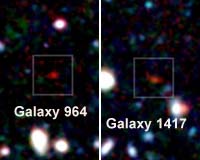
Reporting in the US publication Astrophysical Journal, watchers led by Daniel Stark of the California Institute of Technology (Caltech), say they found six galaxies with a redshift of nine, equivalent to a post-Bang birth of 500 million years.
The team, which included astronomers at the Astrophysics Laboratory in Marseille, southern France, used the giant 10-metre (32.5-feet) Keck telescope in Mauna Kea, Hawaii, over three years.
They finetuned the search by exploiting a phenomenon called gravitational lensing.
Under this, the gravitational force of nearby galaxies bends and focuses the light from more distant clusters.
"We identified six youthful galaxies that were actively forming stars and were located at a distance corresponding to the time when the universe was only 500 million years old, or less than four percent of its current age," said French astronomer Jean-Paul Kneib.
Community
 Carnegie Leads Team Conducting Most Detailed Cosmological Simulation To Date
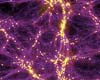 Pittsburgh PA (SPX) Jun 29, 2007
| The content herein, unless otherwise known to be public domain, are Copyright 1995-2006 - SpaceDaily.AFP and UPI Wire Stories are copyright Agence France-Presse and United Press International. ESA PortalReports are copyright European Space Agency. All NASA sourced material is public domain. Additionalcopyrights may apply in whole or part to other bona fide parties. Advertising does not imply endorsement,agreement or approval of any opinions, statements or information provided by SpaceDaily on any Web page published or hosted by SpaceDaily. Privacy Statement |