
 |
 |
 |
 |
 |
 |
 |
 |
 |
 |

| . |  |
. |

Bonn, Germany (SPX) Nov 19, 2010 New stars are born in the Universe around the clock - on the Milky Way, currently about ten per year. From the birth rate in the past, we can generally calculate how populated space should actually be. But the problem is that the results of such calculations do not match our actual observations. "There should actually be a lot more stars that we can see," says Dr. Jan Pflamm-Altenburg, astrophysicist at the Argelander-Institut fur Astronomie of the University of Bonn. So, where are those stars? For years, astronomers worldwide have been looking for a plausible explanation for this discrepancy. In cooperation with Dr. Carsten Weidner from St. Andrews University, Dr. Pflamm-Altenburg and Professor Dr. Pavel Kroupa, Professor of Astrophysics at the University of Bonn, may now have found the solution. It seems that so far, the birth rate has simply been overestimated. But this answer is not quite as simple as it sounds. Apparently, the error of estimation only occurs during periods of particularly high star production. The reason for this lies in the manner in which astronomers calculate the birth rate. "For the local Universe - i.e., the Milky Way as our home and the adjacent galaxies - it is relatively simple," explains Professor Kroupa. "Here we are able to count the young stars one by one, using huge telescopes." The problem with this method is that it only works for our immediate vicinity. But many galaxies are so distant that even the best telescope simply overlooks their small stars. As luck would have it, however, occasionally there is an especially large whopper among the newbie's in the sky. Such a star will, even if it cannot be directly discovered as an individual star, leave its traces in the light of even the farthest galaxies. The number of large whoppers then determines the strength of this trace. In our immediate vicinity, these large whoppers occur with a fixed probability. There are always about 300 lightweights to one "big star baby." This numerical ratio seemed to be universal. So it was sufficient for astronomers to know the number of the large whoppers, for this allowed them to determine the number of new-born stars by simply multiplying the former number by a factor of 300.
Population explosion in space The reason for this, according to this theory, is so-called stellar crowding. For stars are not single children; they are born in groups, as so-called star clusters. At birth, these clusters are always of a similar size - no matter whether they contain 100 star embryos - or 100,000. Consequently, at times of a high birth rate, space can be at a premium in star clusters. Astronomers call such galaxies that are particularly rich in mass "ultra-compact dwarf galaxies," or UCD's for short. In these, things are so tight that some of the young stars fuse during formation. Thus, more stars rich in mass than normal emerge. The "small to large" ratio is then only about 50 to 1. "In other words, we used to estimate the number of newly formed small stars by far too high," explains Dr. Carsten Weidner. The researchers from Bonn and St. Andrews have now corrected the birth rates according to the projections of the stellar crowding theory. With an encouraging result - they actually arrived at the number of stars that can be seen today.
Share This Article With Planet Earth
Related Links University of Bonn Stellar Chemistry, The Universe And All Within It

 Astronomers Discover Merging Star Systems That Might Explode
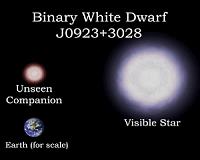
Boston MA (SPX) Nov 17, 2010 Sometimes when you're looking for one thing, you find something completely different and unexpected. In the scientific endeavor, such serendipity can lead to new discoveries. Today, researchers who found the first hypervelocity stars escaping the Milky Way announced that their search also turned up a dozen double-star systems. Half of those are merging and might explode as supernovae in the astr ... read more |
|
|
| The content herein, unless otherwise known to be public domain, are Copyright 1995-2010 - SpaceDaily. AFP and UPI Wire Stories are copyright Agence France-Presse and United Press International. ESA Portal Reports are copyright European Space Agency. All NASA sourced material is public domain. Additional copyrights may apply in whole or part to other bona fide parties. Advertising does not imply endorsement,agreement or approval of any opinions, statements or information provided by SpaceDaily on any Web page published or hosted by SpaceDaily. Privacy Statement |


 del.icio.us
 Digg
Digg Reddit
 YahooMyWeb
 Google
 Facebook


