
Prospects have been fading for an El Nino event in 2014, but now there's a glimmer of hope for a very modest comeback. Scientists warn that unless these developing weak-to-modest El Nino conditions strengthen, the drought-stricken American West shouldn't expect any relief.
The latest sea-level-height data from the NASA/European Ocean Surface Topography Mission (OSTM)/Jason-2 satellite mission show a pair of eastward-moving waves of higher sea level, known as Kelvin waves, in the Pacific Ocean — the third such pair of waves this year.
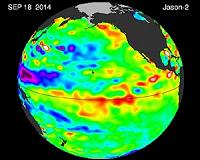
Now crossing the central and eastern equatorial Pacific, these warm waves appear as the large area of higher-than-normal sea surface heights (warmer-than-normal ocean temperatures) hugging the equator between 120 degrees west and the International Dateline. The Kelvin waves are traveling eastward and should arrive off Ecuador in late September and early October.
A series of larger atmospheric "west wind bursts" from February through May 2014 triggered an earlier series of Kelvin waves that raised hopes of a significant El Nino event. Just as the warming of the eastern equatorial Pacific by these waves dissipated, damping expectations for an El Nino this year, these latest Kelvin waves have appeared, resuscitating hopes for a late arrival of the event.
The new image is online here.
For an overview of 2014's El Nino prospects and Kelvin waves, please go here.
Climatologist Bill Patzert of NASA's Jet Propulsion Laboratory, Pasadena, California, says it's too early to know for sure, but he would not be surprised if the latest Kelvin waves are the "last hurrah" for this much-hoped-for El Nino.
"Since February 2014, the prospect of an El Nino has waxed and waned. This late in the season, the best we can expect is a weak to moderate event. What comes next is not yet clear. But for the drought-plagued American West, the possibility of a badly needed drenching is fading," said Patzert.
NASA scientists will continue to monitor the Pacific to see what is in store next for the world's climate.
This image was created with data collected by the U.S./European OSTM/Jason-2 satellite during a 10-day period centered on Sept. 18, 2014. It shows a red and yellow area in the central and eastern equatorial Pacific, indicating that the ocean surface is about 4 to 6 inches (10 to 12 centimeters) above normal. Green indicates near-normal conditions.
These regions contrast with the western equatorial Pacific, where sea levels (blue and purple areas) are 3 to 6 inches (8 to 15 centimeters) lower than normal.
The height of the ocean water relates, in part, to its temperature, and thus is an indicator of the amount of heat stored in the ocean below. As the ocean warms, the water expands and the sea level rises; as it cools, its level falls.
Above-normal height variations along the equatorial Pacific indicate El Nino conditions, while below-normal height variations indicate La Nina conditions. The temperature of the upper ocean can have a significant influence on weather patterns and climate.
This latest image highlights the processes that occur on time scales of more than a year but usually less than 10 years, such as El Nino and La Nina. The image also highlights faster ocean processes such as Kelvin waves. As Patzert says, "Jason-2 is a fantastic Kelvin wave counter." These processes are known as the interannual ocean signal.
To show that signal, scientists refined data for this image by removing trends over the past 21 years, seasonal variations and time-averaged signals of large-scale ocean circulation. For a more detailed explanation of what this type of image means please go here.
The comings and goings of El Nino and La Nina are part of the long-term, evolving state of global climate, for which measurements of sea surface height are a key indicator.
Jason-2 is a joint effort between NASA, the National Oceanic and Atmospheric Administration (NOAA), the French Space Agency Centre National d'Etudes Spatiales (CNES) and the European Organisation for the Exploitation of Meteorological Satellites (EUMETSAT).
JPL manages the U.S. portion of Jason-2 for NASA's Science Mission Directorate, Washington, D.C. In early 2015, NASA and its international partners CNES, NOAA and EUMETSAT will launch Jason-3, which will extend the timeline of ocean surface topography measurements begun by the Topex/Poseidon and Jason 1 and 2 satellites.
Jason-3 will make highly detailed measurements of sea level on Earth to gain insight into ocean circulation and climate change. JPL is a division of the California Institute of Technology.
For a time sequence of the evolution of the 2014 El Nino please go here.
