
 |
 |
 |
 |
 |
 |
 |
 |
 |
 |

| . |  |
. |

Bethesda MD (SPX) Nov 09, 2010 Since the 1970s, a number of geostationary satellites have been placed in the so called "graveyard orbit," an orbit just above the GEO altitude, roughly 100 to 300 km. The sole purpose of this "burial" location is to remove expired satellites from the highly-congested GEO ring about the equator. Although most GEO satellite operators have not taken advantage of removing their old spacecraft, there are over 100 already there. This number will continue to grow, because some 20 GEO birds expire each year, and some of these will be sent to the graveyard. Thus, the total number of graveyard residents will increase indefinitely. Operators that use the "end-of-life" maneuver to rid GEO of future debris feel relieved that they do not have to be concerned about their old satellites interfering with operating birds. After all, as the number of dead satellites in GEO increases, the probability of collisions increases. Once collisions start occurring the frequency of such events will surely increase dramatically. So, the graveyard orbit seems like a good long-term solution to eventual uncontrolled debris generation in GEO. But, hold on one second. There is a well-known theory that the tidal effects of the moon on the Earth are slowly changing the Earth-moon relationship. The moon creates friction due to tidal motion of the oceans. This friction causes a loss of the Earth's rotational energy. The net effect is a slowing of the Earth's spin rate, i.e., a lengthening of the day. However, the period of the GEO orbit is synchronized with the Earth's rotation rate in order to assure satellites placed in this orbit will remain fixed over one longitude. If the Earth's rotation rate changes, then GEO satellites will no longer appear to be stationary. This implies GEO satellite will have to be placed in orbits that match any new rotation rate. As the rate decreases, the altitude for synchronized motion will increase, i.e., GEOs will have to fly at ever higher orbits in order to stay stationary over the Earth. A 10-minute increase in a day will require that GEOs be placed in orbits that are now reserved for expired satellites. This could mean bad news for satellite operators, because the probability of collisions with space debris will increase dramatically. Hold on! Although this may sound alarming, let's take a look at the rate of increase in the day. Estimates indicate that the day will increase just a few minutes over the next 20 million years. Given the typical satellite life span of less than 20 years, there appears to be no immediate concern regarding maintenance of station or increases in collision threats at GEO. However, GEO satellite operators need to be aware of many subtle influences on this all-important orbit. Such influences and a complete treatment of geostationary orbits and operations are covered in Launchspace's new course for 2011: "Advanced Geostationary Orbit Mechanics and Operations." This will soon also be available on demand at your facility.
Share This Article With Planet Earth
Related Links Launchspace Space Technology News - Applications and Research

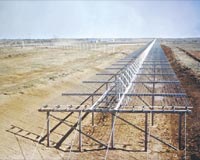 Space Fence Program Completes Critical Milestone
Tewksbury MA (SPX) Nov 03, 2010 Raytheon Company has completed a successful system design review (SDR) for the Space Fence program. Space Fence will provide the U.S. Air Force enhanced space surveillance capability to track and detect space objects. "As our nation's defense becomes increasingly more dependent on the space domain, a system like Space Fence will be a critical component in the Space Surveillance Network, tr ... read more |
|
|
| The content herein, unless otherwise known to be public domain, are Copyright 1995-2010 - SpaceDaily. AFP and UPI Wire Stories are copyright Agence France-Presse and United Press International. ESA Portal Reports are copyright European Space Agency. All NASA sourced material is public domain. Additional copyrights may apply in whole or part to other bona fide parties. Advertising does not imply endorsement,agreement or approval of any opinions, statements or information provided by SpaceDaily on any Web page published or hosted by SpaceDaily. Privacy Statement |


 del.icio.us
 Digg
Digg Reddit
 YahooMyWeb
 Google
 Facebook


