
 |
 |
 |
 |
 |
 |
 |
 |
 |
 |

| . |  |
. |
The Great Cosmic Challenge
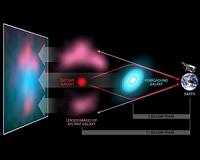
London, UK (SPX) Oct 30, 2008 today cosmologists are challenging the world to solve a compelling statistical problem, to bring us closer to understanding the nature of dark matter and energy which makes up 95 per cent of the 'missing' universe. The GRavitational lEnsing Accuracy Testing 2008 (GREAT08) PASCAL Challenge is being set by 38 scientists across 19 international institutions, with the aim of enticing other researchers to crack it by 30 April 2009. "The GREAT08 PASCAL Challenge will help us answer the biggest question in cosmology today: what is the dark energy that seems to make up most of the universe? We realised that solving our image processing problem doesn't require knowledge of astronomy, so we're reaching out to attract novel approaches from other disciplines," says Dr Sarah Bridle, UCL Physics and Astronomy, who is leading the challenge alongside Professor John Shawe-Taylor, Director of the UCL Centre for Computational Statistics and Machine Learning. Twenty per cent of our universe seems to be made of dark matter, an unknown substance that is fundamentally different to the material making up our known world. Seventy-five per cent of the universe appears to be made of a completely mysterious substance dubbed dark energy. One possible explanation for these surprising observations is that Einstein's law of gravity is wrong. The method with the greatest potential to discover the nature of dark energy is gravitational lensing, in which the shapes of distant galaxies are distorted by the gravity of the intervening dark matter. "Streetlamps appear distorted by the glass in your bathroom window and you could use the distortions to learn about the varying thickness of the glass. In the same way, we can learn about the distribution of the dark matter by looking at the shapes of distant galaxies," says Dr. Sarah Bridle. The observed galaxy images appear distorted and their shapes must be precisely disentangled from observational effects of sampling, convolution and noise. The problem being set, to measure these image distortions, involves image analysis and is ideally matched to experts in statistical inference, inverse problems and computational learning, amongst other scientific fields. Cosmologists are gearing up for an exciting few years interpreting the results of new experiments designed to uncover the nature of dark energy, including the ground-based Dark Energy Survey (DES) in Chile and Pan-STARRS in Hawaii, and space missions by the European Space Agency (Euclid) and by NASA and the US Department of Energy (JDEM). Methods developed to solve the GREAT08 Challenge will help the analysis of this new data. Community Email This Article Comment On This Article Share This Article With Planet Earth
Related Links GREAT08 Challenge Stellar Chemistry, The Universe And All Within It
 Crossing A Bridge To Nowhere
 Tel Aviv, Israel (SPX) Oct 21, 2008
Despite thousands of years of research, astronomers know next to nothing about how the universe is structured. One strong and accepted theory is that large galaxies are clustered together on structures similar to giant soap bubbles, with tinier galaxies sprinkled on the surface of this "soapy" layer. |
|
|

| The content herein, unless otherwise known to be public domain, are Copyright 1995-2007 - SpaceDaily.AFP and UPI Wire Stories are copyright Agence France-Presse and United Press International. ESA Portal Reports are copyright European Space Agency. All NASA sourced material is public domain. Additional copyrights may apply in whole or part to other bona fide parties. Advertising does not imply endorsement,agreement or approval of any opinions, statements or information provided by SpaceDaily on any Web page published or hosted by SpaceDaily. Privacy Statement |
 del.icio.us
 Digg
Digg Reddit
 YahooMyWeb
 Google
 Facebook