
. Military Space News .
The Last Confessions Of A Dying Star

Credit: NASA/ESA/Hubble Heritage Team (STScI/AURA)
by Staff Writers
Baltimore MD (SPX) Mar 05, 2008
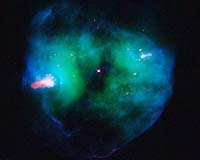
Probing a glowing bubble of gas and dust encircling a dying star, NASA's Hubble Space Telescope reveals a wealth of previously unseen structures. The object, called NGC 2371, is a planetary nebula, the glowing remains of a sun-like star. The remnant star visible at the center of NGC 2371 is the super-hot core of the former red giant, now stripped of its outer layers. Its surface temperature is a scorching 240,000 degrees Fahrenheit.

NGC 2371 lies about 4,300 light-years away in the constellation Gemini.

The Hubble image reveals several remarkable features, most notably the prominent pink clouds lying on opposite sides of the central star. This color indicates that they are relatively cool and dense, compared to the rest of the gas in the nebula.

Also striking are the numerous, very small pink dots, marking relatively dense and small knots of gas, which also lie on diametrically opposite sides of the star. These features appear to represent the ejection of gas from the star along a specific direction.

The jet's direction has changed with time over the past few thousand years. The reason for this behavior is not well understood, but might be related to the possible presence of a second star orbiting the visible central star.

A planetary nebula is an expanding cloud of gas ejected from a star that is nearing the end of its life. The nebula glows because of ultraviolet radiation from the hot remnant star at its center. In only a few thousand years the nebula will dissipate into space. The central star will then gradually cool down, eventually becoming a white dwarf, the final stage of evolution for nearly all stars.

The Hubble picture of NGC 2371 is a false-color image, prepared from exposures taken through filters that detect light from sulfur and nitrogen (red), hydrogen (green), and oxygen (blue). These images were taken with Hubble's Wide Field Planetary Camera 2 in November 2007, as part of the Hubble Heritage program.

Community
Email This Article
Comment On This Article

Related Links
Stellar Chemistry, The Universe And All Within It


Memory Foam Mattress Review
Newsletters :: SpaceDaily :: SpaceWar :: TerraDaily :: Energy Daily
XML Feeds :: Space News :: Earth News :: War News :: Solar Energy News


Small Helper Stars Needed For Massive Star Formation
Berkeley CA (SPX) Mar 03, 2008
In order for a rare, massive star to form inside an interstellar cloud of gas and dust, small "helper" stars about the size of the sun must first set the stage, according to a new theory proposed by astrophysicists at the University of California, Berkeley, and Princeton University.


  • Taiwan boosts military spending amid China increase
  • China announces big rise in military spending, amid US tensions
  • Pentagon voices concern over China's military power
  • British FM says China must prove itself 'responsible'

  • US needs nuclear weapons for rest of century: general
  • Israel has power to defend against Iran: Olmert
  • UN sanctions, incentives to end Iran nuclear standoff
  • Security Council tightens UN sanctions on Iran

  • India, Israel to jointly develop anti-aircraft missiles
  • Pakistan says Indian missile test to trigger arms race: report
  • India test-fires sea-based nuclear-capable missile: ministry
  • AIM-9X Enters The US Navy's Weapons System User Program

  • US offers Poland military plan for missile shield: ministry
  • US, Czech on cusp of missile shield deal
  • Czech PM in US touts missile shield plan
  • Czech, Poland close to deal on US anti-missile shield: officials

  • Environmentalists climb on Heathrow jet in airport protest: officials
  • NASA opens a rotary wing research project
  • All-star line-up at first Singapore Airshow
  • Military Aircraft To Perform Aviation Safety Research

  • QinetiQ Selects Aonix PERC For Taranis UAV
  • Autonomous Technology Is Cool For CATS
  • Assembly Starts Of Taranis Unmanned Combat Air Vehicle
  • Boeing-Insitu ScanEagle UAV Achieves 10,000 Flight Hours In Support Of Australian Army Operations

  • Iran still backing extremists in Iraq: US general
  • Feature: Persistence, luck pay off in Iraq
  • Bush refuses to commit to pulling more troops from Iraq
  • Feature: Coalition, al-Qaida set stage

  • URI Selected By DHS To Co-lead New Center Of Excellence For Explosives Detection
  • Betting On Tanks To Control The Battlefield Part Two
  • Lockheed Martin's DAGR Continues Successful Test Program
  • ATK Precision Programs Cap Milestone Nine Day Run With Three Demanding Shots

  • The content herein, unless otherwise known to be public domain, are Copyright 1995-2007 - SpaceDaily.AFP and UPI Wire Stories are copyright Agence France-Presse and United Press International. ESA Portal Reports are copyright European Space Agency. All NASA sourced material is public domain. Additional copyrights may apply in whole or part to other bona fide parties. Advertising does not imply endorsement,agreement or approval of any opinions, statements or information provided by SpaceDaily on any Web page published or hosted by SpaceDaily. Privacy Statement