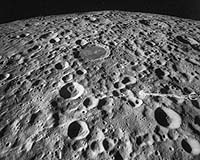
File image of Lunar mountains
File image of Lunar mountains |
The moon's dust-covered slopes are good places to ski. There's plenty of powder, moguls and, best of all, low-gravity. With only 1/6th g holding them down, skiers and snowboarders can do tricks they only dreamed of doing on Earth. How about an octuple-twisting quadruple backflip? Don't worry. Crashes happen in slow-motion, so it won't hurt so much to wipe out.
And there's a perfect spot for the Olympic Village: the crater Plato. Most people don't know it, but Plato of ancient Greece was not only a philosopher, but also an Olympic champion. Twice he won the pankration competition--a grueling mix of boxing and wrestling.
A crater named after Plato sounds like a good place for Olympic athletes to stay. The site is flat-bottomed, filled with raw materials for building stadia and habitats, and like Torino, Italy, the site of this year's games, Plato is near the Alps.
That is, the lunar Alps.
The lunar Alps are a range of mountains on the moon named after the Alps of Europe. They are similar to their Earthly counterparts in height, breath and spectacle. Since the modern Olympics began in 1896, most of the winter games have been held in the Alps. Why should the moon be any different?
You can see the lunar Alps using a small backyard telescope. This week is an excellent time to try: Step outside at sundown and look up at the moon. The Olympic Village, crater Plato, is a conspicuous dark oval on the northern shore of Mare Imbrium, the "Sea of Rains." Your unaided eye is sufficient to see it.
Next, train your telescope on Plato. The Alps begin there. They stretch around the rim of the Sea of Rains from Plato through the spectacular Alpine Valley to towering Mont Blanc. Amateur astronomer Alan Friedman of Buffalo, New York, used a 10-inch telescope to take this picture of the scene:
The Alps of Earth grew over a period of millions of years. Powered by plate tectonics, sections of Earth's crust pushed together, squeezing the land to produce jagged mountains. The range stretches from France through Italy all the way to Albania; the tallest peak is Mont Blanc, 15,700 ft or 4800 m high.
The Alps of the moon were formed in an instant some 4 billion years ago when a huge asteroid struck. The collision blasted out the Sea of Rains, which, contrary to its name, is a big crater, not a big sea. The Alps are "splash" from the impact.
In those early days, lunar Alps were probably as jagged and rough as the Alps of Earth. But in eons that followed, meteoroids relentlessly pounded the moon, smashing rocks into dust and blunting the sharp edges of mountain peaks.
Today's lunar Alps are a bit shorter (the moon's Mont Blanc is only 11,800 ft or 3600 m high) and a lot smoother than their terrestrial counterparts--perfect for Olympics.
In the weeks ahead, Science@NASA will publish a series of stories exploring the physics of low-gravity Olympics. Is an octuple-twisting quadruple backflip really possible? Should snowboarders be allowed to pilot lunar landers? How is a bobsled like a spaceship? Stay tuned for the answers to these questions and others--with exclusive video from Olympic athletes.
Let the Games begin!
Related Links
 Ancient Impacts Created Man In The Moon
 Columbus, Ohio (SPX) Feb 9, 2006
| The content herein, unless otherwise known to be public domain, are Copyright 1995-2006 - SpaceDaily.AFP and UPI Wire Stories are copyright Agence France-Presse and United Press International. ESA PortalReports are copyright European Space Agency. All NASA sourced material is public domain. Additionalcopyrights may apply in whole or part to other bona fide parties. Advertising does not imply endorsement,agreement or approval of any opinions, statements or information provided by SpaceDaily on any Web page published or hosted by SpaceDaily. Privacy Statement |