|
 |
 |
 |
 |
 |
 |
 |
 |
 |

| . |  |
. |
The Moon Eclipses Jupiter
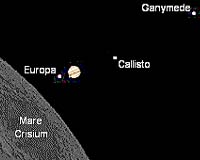
Huntsville AL (SPX) Nov 30, 2004 Picture this: You're an astronaut driving a moon buggy across the dusty plains of Mare Crisium. It's nighttime, but not dark. There's a big bright gibbous Earth hanging low behind your back, and it lights up the moonscape, softly, as far as the eye can see. You turn off the headlights and hit the accelerator. That's when it happens: From behind a nearby mountain, up pops Jupiter, brighter than any star in the sky. It winks in and out of the jagged ridgeline. Staring at the sky, you run into a crater. Don't you hate that? Next time, pick a spot with smaller potholes - like New York City. On Tuesday morning, Dec. 7th, about an hour before sunrise, people in New York can see Jupiter rise over the Moon's mountains. At precisely 5:05 a.m. EST, Jupiter will pop up from behind the Moon, not far from the lunar "Sea of Crises" (Mare Crisium). It's the tail end of an eclipse or "lunar occultation." The crescent Moon covers Jupiter at 3:56 a.m. EST and uncovers it at 5:05 a.m. EST. New York City isn't the only place. The eclipse will be visible across the entire eastern two-thirds of North America. Exact times vary depending on location. Check the table below for selected cities or click here for a longer list. When the time comes, go outside and face southeast. Jupiter and the Moon will be about one third of the way up the sky. They're bright enough to beam through city lights. The only danger is that a building might get in the way, so pick a spot with a clear view of the southeastern horizon. Note that the end of the eclipse is better than the beginning. The eclipse begins on the sunlit edge of the Moon. The glare there is intense. The eclipse ends on the other side where the only source of illumination is gentle ghostly Earthshine. Jupiter is twice as bright as Sirius (the brightest of all stars) and when it rises above the Moon's dark edge ... wow! You can see all this with your eyes - no telescope required. But if you have a small 'scope, try it. You can see Jupiter's fat cloudy disk emerging behind the jagged lunar terrain. It takes a full minute. You can also see Jupiter's moons: Callisto and Ganymede appear 5 to 15 minutes before Jupiter does. Europa appears about 2 minutes afterward. (Io is hidden behind Jupiter at the time.) And what if you don't live in the eclipse zone? Go outside anyway. Even a near miss is worth seeing. Jupiter and the Moon are going to be a fraction of a degree apart. When two objects in the sky get so close together, they're spellbinding. You're on the Moon, going fast, kicking up dust and staring at Jupiter. Hard to imagine? It's easy on Dec. 7th. Just don't turn off your headlights. Related Links SpaceDaily Search SpaceDaily Subscribe To SpaceDaily Express  Jupiter's Gets All Spotty In Rare Triple Moon Transit
 Moffett Field CA (SPX) Nov 05, 2004
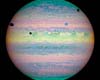
At first glance, Jupiter looks like it has a mild case of the measles. Five spots - one colored white, one blue, and three black - are scattered across the upper half of the planet. |
|
|

| The content herein, unless otherwise known to be public domain, are Copyright 1995-2006 - SpaceDaily.AFP and UPI Wire Stories are copyright Agence France-Presse and United Press International. ESA PortalReports are copyright European Space Agency. All NASA sourced material is public domain. Additionalcopyrights may apply in whole or part to other bona fide parties. Advertising does not imply endorsement,agreement or approval of any opinions, statements or information provided by SpaceDaily on any Web page published or hosted by SpaceDaily. Privacy Statement |