
 |
 |
 |
 |
 |
 |
 |
 |
 |
 |

| . |  |
. |

Baltimore MD (SPX) Apr 14, 2011 New Horizons is healthy and on course. In mid-March, our spacecraft passed the orbit of Uranus, more than 19 astronomical units (AU) from the sun. In fact, we're now almost 20 times as far from the sun as the Earth is. If you were to make a scale-model solar system in your neighborhood, with the sun at the location of your home, and the Earth at your neighbor's house, then New Horizons is 20 houses down the street - way, way out there! Imagine that - I mean, pinch me, we are really far now! Although we still have about 12 more AU (or in my analogy above, "houses") to go to reach our rendezvous with Pluto in 2015, some 32 AU from the sun, you can see that we're very far into the journey. As we continue that journey through 2011, there's much more going on than just mileage markers and planet crossings. Our next big milestone is a nearly two-month-long annual wakeup of our spacecraft from hibernation that begins May 9 and concludes July 1. During that wakeup we'll check out the spacecraft's prime and backup systems as well as the seven scientific payloads. We'll also do a great deal of spacecraft tracking to refine our knowledge of our exact trajectory to evaluate whether we'll need a small course correction next year, like the maneuvers we made in 2007 and 2010. We'll also update our fault detection and protection software in preparation for the Pluto encounter. Speaking of the encounter, we'll conduct a special encounter-related test on May 20 using our radio science experiment. Something very rare and special happens that day - the Earth, as seen from New Horizons, will be "occulted" (that is, blocked) by the moon. This will allow us to practice, for the first time, the type of radio occultation we'll perform at Pluto and Charon. Only three such alignments occur along our journey to Pluto, and they all happen in 2011 and early 2012. We're looking forward to the May 20 test very much, because it'll help us work out any bugs in our Pluto and Charon occultation plans and provide a good simulation for the Deep Space Network team that has to aim its giant antennas precisely at New Horizons and transmit the special signals to create the occultation experiment. We'll conduct a similar test next January to further refine our procedures and techniques. And there's more going on still. Most importantly, in my mind, is that this month, and throughout summer and fall, we'll use huge telescopes to search for the Kuiper Belt objects beyond Pluto that we'll visit in our extended mission - assuming one is approved. We'll have more to tell you about that in upcoming news notes. We're also putting the final touches on the eight days of encounter sequencing that fall just before and after our nine-day-long "core" load near Pluto closest approach. Once we complete this in late 2011, we'll sequence the previous 17 days of approach to Pluto that take us from 21 days out to four days out. The design, implementation and testing of these encounter timelines and command sequences requires exquisite attention to detail and long hours of careful work by many people on the project. We'll have more to say about that later, too. Something else of note: In late June, New Horizons team members led by Drs. Leslie Young and Cathy Olkin will head to Australia to record a new set of stellar occultations of Pluto, Charon, and possibly even Pluto's small moon Hydra. These events will tell us whether Pluto's atmosphere is beginning to cool and collapse to the surface, as some scientists have predicted, and allow us to refine knowledge of the sizes of Pluto, Charon and Hydra. I know that when Leslie and Cathy are doing these observations, their thesis advisor, MIT's Jim Elliott, will be on their mind. Jim, one of the leading planetary astronomers of his time and part of the New Horizons scientific collaboration team, passed away last month - a tragic loss for both his family and planetary science. Our condolences go out to Jim's family and many colleagues. I'll conclude my update with a shout out of thanks to all the people who work on New Horizons today, and all those who worked on it when we were building and launching the mission. More than 2,500 people across the United States, from dozens of companies, universities, national labs and NASA installations, have been directly involved in the project. To all of them we all owe a great debt of appreciation. They made this epic journey across the abyss of our solar system possible. Almost before you know it, in 2015, their handiwork will revolutionize what humankind knows about the Pluto system, dwarf planets and the Kuiper Belt. And just like the milestone of passing Uranus' orbit and knowing we only have one more such milestone ahead (at Neptune) before we reach our goal, sometimes I have to pinch myself about what a wonderful enterprise space exploration is, and how mounting a journey like ours requires the expertise and dedication of so many people. Thanks again for following our journey across the ocean of space, to a truly new frontier. And keep on exploring - just as we do!
Share This Article With Planet Earth
Related Links View The PI's Perspective Archive The million outer planets of a star called Sol

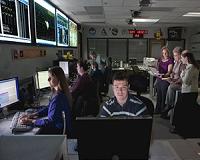 Course Correction Keeps New Horizons On Path To Pluto
Baltimore MD (SPX) Jul 02, 2010 A short but important course-correction maneuver kept New Horizons on track to reach the "aim point" for its 2015 encounter with Pluto. The deep-space equivalent of a tap on the gas pedal, the June 30 thruster-firing lasted 35.6 seconds and sped New Horizons up by just about one mile per hour. But it was enough to make sure that New Horizons will make its planned closest approach 7,7 ... read more |
|
|
| The content herein, unless otherwise known to be public domain, are Copyright 1995-2010 - SpaceDaily. AFP and UPI Wire Stories are copyright Agence France-Presse and United Press International. ESA Portal Reports are copyright European Space Agency. All NASA sourced material is public domain. Additional copyrights may apply in whole or part to other bona fide parties. Advertising does not imply endorsement,agreement or approval of any opinions, statements or information provided by SpaceDaily on any Web page published or hosted by SpaceDaily. Privacy Statement |


 del.icio.us
 Digg
Digg Reddit
 YahooMyWeb
 Google
 Facebook


