|
 |
 |
 |
 |
 |
 |
 |
 |
 |

| . |  |
. |
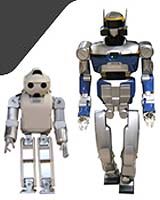
The Second Humanoid Robot In France
Montpellier, France (SPX) Feb 21, 2007 The HOAP3 humanoid robot has just arrived at the Laboratory for Computer Science, Robotics and Microelectronics of Montpellier (LIRMM - CNRS - University of Montpellier 2). This platform supplements the one that was installed at the LAAS in Toulouse last June. They were both made in Japan and represent a strong robotics research potential for France. Research activities in the field of human robotics are expanding rapidly. The establishment of the JRL (Joint Japanese-French Robotics Laboratory) based in both Japan (Tsukuba) and France (Toulouse-LAAS and Montpellier-LIRMM) contributed strongly to the realization, reinforcement and dynamization of the robotics research community in this field. The two humanoid robots are at the core of JRL's research. The acquisition of HOAP3 by LIRMM, 50% co-financed by the CNRS, is part of this process. Within the framework of JRL-France, the LIRMM will thus offer the national community an open experimental platform for the validation of models or control methods contributing to ambulation and the handling of objects while maintaining balance. This 8.8 kg, 60 cm tall robot has 28 motorized articulations. It has a large number of sensors including accelerometers, rate gyros, an infra-red range finder, pressure sensors and two cameras. This unit is based around a completely open software platform (RTLinux) allowing all of the researchers interested to freely evaluate and test their new theoretical developments concerning the modeling, control, vision or learning of these. This platform supplements the one already installed at LAAS in Toulouse, the HRP2 robot, which is more realistic because it is on a "human scale," but also more complex. HOAP3 will allow for very rapid progress because its use is simple and does not require prior validations on a simulator. Furthermore, the software platform used to control the robot will facilitate the integration and the harnessing of work already developed with Linux. On the other hand, the fact that HOAP3 is small means that it cannot perform all of the tasks that a humanoid robot might do in a life-size environment. For these tests, the platform installed at LAAS will thus be complementary. Lastly, HOAP3 has a wireless communication link that allows it to handle teleoperation work or collaboration of mobile robots. One of LIRMM's hopes is to soon have several humanoids so that it can study robot cooperation. Email This Article
Related Links  Ann Arbor, MI (SPX) Feb 11, 2007
A robotic exoskeleton controlled by the wearer's own nervous system could help users regain limb function, which is encouraging news for people with partial nervous system impairment, say University of Michigan researchers. The ankle exoskeleton developed at U-M was worn by healthy subjects to measure how the device affected ankle function. |
|
|

| The content herein, unless otherwise known to be public domain, are Copyright 1995-2006 - SpaceDaily.AFP and UPI Wire Stories are copyright Agence France-Presse and United Press International. ESA PortalReports are copyright European Space Agency. All NASA sourced material is public domain. Additionalcopyrights may apply in whole or part to other bona fide parties. Advertising does not imply endorsement,agreement or approval of any opinions, statements or information provided by SpaceDaily on any Web page published or hosted by SpaceDaily. Privacy Statement |